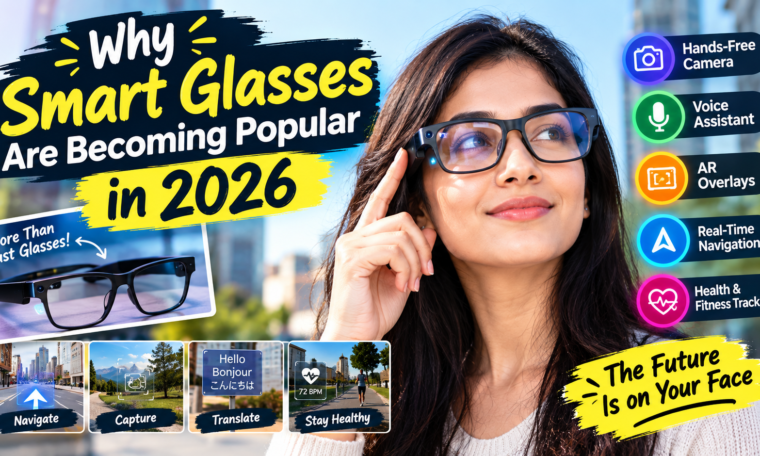
Why Smart Glasses Are Becoming Popular in 2026
Smart glasses have moved beyond the experimental gadget category and are becoming a more visible part of the wearable technology market. Why smart glasses are becoming popular in 2026 is closely connected to the rapid development of artificial intelligence, hands-free computing, better designs and more practical everyday features.
Unlike earlier smart glasses that often focused on futuristic displays, today’s popular models can combine cameras, microphones, open-ear audio and AI assistants inside familiar-looking frames.
The market numbers also show growing interest. Omdia reported that global AI-glasses shipments reached 4.2 million units in the first half of 2026, up 127% year over year. Counterpoint Research reported an even broader 263% year-over-year increase in global AI-glasses shipments during the same period, with display-less AI glasses accounting for 96% of shipments.
So, what is driving this growth?
1. AI Is Making Smart Glasses More Useful
The biggest change in smart glasses is the integration of AI.
Earlier wearable devices often depended on simple commands or smartphone-connected functions. Modern AI glasses can provide more conversational assistance, answer questions, recognize objects, interpret information and perform other supported tasks.
The idea is simple: instead of reaching into your pocket to use a smartphone, you can interact with an AI assistant through glasses.
That hands-free approach can be useful while walking, traveling, shopping, cooking or working.
Omdia says vendors are making the value proposition clearer through three major areas: hands-free photo and video capture, open-ear audio and AI assistance.
2. Hands-Free Photography Is a Major Attraction
Smartphone cameras are powerful, but using a phone is not always convenient.
Smart glasses can provide a different way to capture photos and videos because the camera is positioned from the user’s point of view.
This can be useful for:
- Travel videos
- Daily-life clips
- Walking tours
- Family moments
- First-person content
- Short-form social media videos
For creators, the hands-free format can make spontaneous content easier to capture.
The popularity of this feature is also important because it makes smart glasses useful even when the user is not actively interested in augmented reality.
3. They Look More Like Normal Glasses
Design has played an important role in making smart glasses more approachable.
Some earlier wearable products looked noticeably futuristic. Newer smart glasses increasingly resemble conventional sunglasses or eyeglasses.
That makes them easier to integrate into everyday outfits.
IDC reported that audio, display-less glasses represented 70.3% of XR glasses and headset shipments in Q2 2026, showing how strongly consumers are gravitating toward glasses that provide useful functions without requiring a visual display.
This is an important shift.
Consumers do not necessarily need a screen in front of their eyes to find smart glasses useful.
4. Open-Ear Audio Makes Them Practical
Smart glasses can also function as wearable audio devices.
Instead of placing earbuds inside your ears, open-ear speakers can allow users to listen to music, podcasts, calls or AI responses while remaining aware of their surroundings.
This can be useful for people who prefer not to wear traditional earbuds throughout the day.
It also means one pair of glasses can combine several devices into one:
Eyewear + camera + microphone + speakers + AI assistant.
That combination is one reason smart glasses are becoming more interesting to consumers.
5. Smart Glasses Are Becoming More Useful for Creators
Content creation is another factor behind the growing interest.
Short-form video has made spontaneous and authentic footage increasingly valuable for social media creators.
Smart glasses can provide a first-person perspective without requiring the creator to hold a phone or camera.
A travel creator, for example, could record a walking experience while keeping both hands free.
Similarly, someone attending an event could capture short clips without constantly taking a smartphone out of a pocket or bag.
This does not mean smart glasses will replace traditional cameras. Instead, they offer another way to capture moments quickly.
6. AI Glasses Can Help With Everyday Information
One of the most interesting developments is the ability to interact with AI while looking at the real world.
Depending on the device and software, AI glasses can potentially help users identify objects, answer questions about what they are seeing, translate information or provide contextual assistance.
These capabilities are still developing, and features differ significantly between products.
However, the basic idea is powerful: AI can become available without requiring a separate screen.
That could eventually change how people interact with digital information.
7. Smart Glasses Are Growing in India
India is also becoming an important market to watch.
CyberMedia Research projected that India’s smart-glasses market could exceed 3.2 million units by 2030, representing roughly 16 times the estimated market size around 2025. The research attributed the expected growth to AI integration, lifestyle use cases and the success of products such as Meta’s Ray-Ban smart glasses.
More recent Indian wearable-market data also points toward growing interest in smart glasses.
Moneycontrol reported in September 2026 that smart glasses were among the faster-growing pockets of India’s wearable market, even as overall wearable shipments declined.
This suggests that Indian consumers are not simply buying more wearables. There is also a shift toward newer products with different use cases.
8. Accessibility Is Another Important Use Case
Smart glasses may also become valuable as accessibility tools.
Hands-free AI assistance can potentially help people access information without constantly using a smartphone.
Features such as voice interaction, captions, translation and object recognition could support users in different situations.
The exact benefits depend on the device and software, but accessibility is one area where AI-powered eyewear could provide meaningful everyday assistance.
9. The Smartphone Is Not Being Replaced Yet
Despite the excitement around smart glasses, smartphones remain central to the experience.
Many smart glasses still depend on a smartphone connection for setup, internet access, apps, storage or additional processing.
That means today’s smart glasses are better understood as companions to smartphones rather than complete replacements.
The long-term direction could be different as AI assistants, connectivity and on-device processing improve.
For now, however, smart glasses generally complement existing devices.
10. Better Hardware Is Helping Adoption
Hardware improvements are also making the category more practical.
Manufacturers are working on lighter frames, better microphones, improved cameras, longer battery life and stronger wireless connectivity.
At the same time, AI processing is becoming more efficient.
IDC’s Q1 2026 data showed display-less smart-glasses shipments growing 167% year over year to approximately 2.25 million units in a single quarter.
That growth indicates that consumers are increasingly willing to consider glasses as a technology product rather than simply an accessory.
11. Privacy Remains a Major Challenge
The growth of smart glasses also comes with an important concern: privacy.
Because many AI glasses include cameras and microphones, people around the wearer may worry about being recorded without their knowledge.
Recent reporting has highlighted public concerns and legal scrutiny surrounding camera-equipped AI glasses, particularly around recording and how captured data is handled.
Manufacturers therefore face an important challenge: making smart glasses useful while giving users and bystanders greater confidence about when recording is happening and how information is processed.
Privacy features, clear recording indicators and transparent data policies could become increasingly important when consumers choose between smart-glasses models.
12. Display-Free Smart Glasses Are Leading the Market
One surprising trend in 2026 is that the fastest-growing smart glasses do not necessarily have built-in displays.
Counterpoint Research reported that display-less AI glasses accounted for 96% of global AI-glasses shipments in the first half of 2026.
This matters because it challenges the assumption that smart glasses need augmented-reality screens to become successful.
Instead, consumers appear to be responding to simpler features:
- AI assistance
- Photography
- Video recording
- Music
- Calls
- Voice commands
- Hands-free information
A lighter, simpler product can therefore have a broader appeal than a complicated AR headset.
What Makes Smart Glasses Different From Smartwatches?
Smartwatches place information on your wrist, while smart glasses can bring technology closer to your eyes, ears and voice.
A smartwatch is useful for notifications, fitness tracking and quick interactions.
Smart glasses focus more heavily on:
- Hands-free interaction
- Camera capture
- Audio
- AI assistance
- Voice commands
- Real-world context
The two categories can work together rather than compete directly.
Are Smart Glasses Worth Buying in 2026?
Whether smart glasses are worth buying depends on how you plan to use them.
They may be appealing to creators, travelers, technology enthusiasts and people who frequently want hands-free access to audio, cameras or AI.
However, buyers should check battery life, camera quality, audio performance, smartphone compatibility, AI features, privacy controls and price before purchasing.
The category is developing quickly, so features can vary considerably between models.
Final Thoughts
The answer to why smart glasses are becoming popular in 2026 comes down to one major change: smart glasses are becoming less about futuristic displays and more about practical everyday assistance.
AI, hands-free cameras, open-ear audio, voice interaction and increasingly familiar designs are helping turn smart glasses into a more understandable consumer product.
Market data confirms that interest is growing rapidly, with Omdia reporting 4.2 million AI-glasses shipments globally during the first half of 2026 and IDC reporting strong growth in display-less smart glasses.
The technology still faces challenges, especially around privacy, battery life, pricing and long-term usefulness. Nevertheless, 2026 is an important year for smart eyewear because manufacturers are moving the category from experimental hardware toward everyday wearable technology.
For consumers, the biggest question is no longer simply whether smart glasses can work. It is which everyday tasks they can make easier without requiring you to take your smartphone out of your pocket.