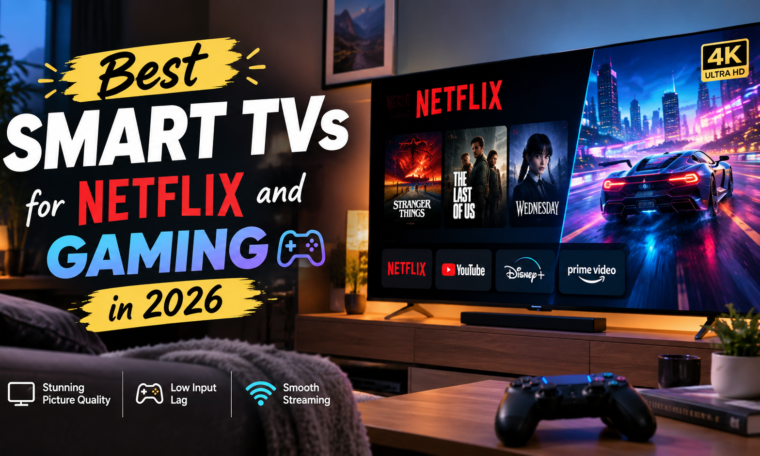
Finding the best Smart TV for Netflix and gaming in 2026 is no longer just about choosing the biggest screen. Modern televisions combine 4K resolution, HDR, smart streaming platforms, high refresh rates, HDMI 2.1, VRR, and low-latency gaming features. For Indian buyers, the market now includes everything from affordable LED and QLED models to premium OLED and Mini-LED televisions.
If you enjoy Netflix, Prime Video, YouTube, and other streaming platforms but also want a TV for a PS5, Xbox, or gaming PC, you need to look beyond basic picture quality. A good entertainment TV should deliver sharp images for movies while also responding quickly when you press a controller button. In 2026, 120Hz panels, HDMI 2.1, VRR, and ALLM are some of the most useful gaming specifications to look for.
This guide explains what to look for and highlights popular Smart TV options for Netflix and gaming in India.
What Makes a Smart TV Good for Netflix and Gaming?
Netflix viewing and gaming place different demands on a television.
For Netflix, you generally want excellent contrast, accurate colors, good HDR performance, a reliable smart platform, and strong audio.
Gaming requires additional features such as a high refresh rate, low input lag, HDMI 2.1, VRR, and ALLM.
A 120Hz TV can display supported games at up to 120 frames per second, while HDMI 2.1 provides the bandwidth needed for 4K at higher refresh rates on compatible devices.
Therefore, the ideal TV combines both sets of features rather than focusing on only one.
Best Smart TVs for Netflix and Gaming in 2026
1. LG OLED TVs
LG’s OLED range remains an important option for buyers who want strong movie performance alongside advanced gaming features.
OLED technology can produce very deep blacks because individual pixels can turn off completely. That makes dark scenes in movies and games look more defined, particularly in a dim room.
LG’s gaming-focused televisions can also offer HDMI 2.1, VRR, ALLM, and high refresh rates. LG’s current gaming information lists features such as NVIDIA G-Sync, AMD FreeSync Premium, VRR, HGiG, and ALLM on selected models.
Why consider LG OLED?
- Excellent contrast
- Deep black levels
- 4K resolution
- High refresh rates on selected models
- HDMI 2.1
- VRR and ALLM
- Strong streaming features
For movie lovers who also play console or PC games, OLED can provide a particularly cinematic experience.
2. Samsung OLED and Neo QLED TVs
Samsung offers both OLED and Neo QLED televisions for consumers who want premium entertainment and gaming capabilities.
Samsung’s gaming TVs can include multiple HDMI 2.1 ports, ALLM, and support for high refresh rates on compatible models. The company says selected TVs can support PC gaming at up to 4K 240Hz, 165Hz, or 144Hz depending on the model.
Samsung’s OLED models can deliver strong contrast and vivid colors, while Neo QLED models use Mini-LED technology to provide high brightness and more precise backlighting.
Key features to look for:
- OLED or Neo QLED display
- 4K resolution
- HDMI 2.1
- VRR
- ALLM
- High refresh rate
- HDR support
- Gaming menu features
Samsung can therefore be interesting for people who watch movies during the day and game regularly.
3. Sony BRAVIA TVs
Sony BRAVIA televisions are another popular choice for viewers who care about movie quality and gaming.
Sony’s current BRAVIA gaming features include 4K/120fps support, Variable Refresh Rate, and Auto Low Latency Mode on compatible models.
Selected BRAVIA models also use Google TV, which makes it easy to access streaming applications and personalized recommendations.
For PlayStation users, Sony’s ecosystem can also provide useful gaming-related features on compatible televisions.
Highlights include:
- 4K picture quality
- Google TV on selected models
- HDR support
- HDMI 2.1 on selected models
- 4K/120Hz gaming
- VRR
- ALLM
Check the exact model before buying because not every BRAVIA television has the same gaming specifications.
4. TCL QLED and Mini-LED TVs
TCL has become an interesting option for buyers who want gaming specifications without immediately moving into the premium TV price range.
Some TCL models offer QLED or Mini-LED display technology, high refresh rates, HDMI 2.1, and gaming-focused features.
Current Indian TV listings show several TCL models with HDMI 2.1, including QLED televisions.
Why consider TCL?
- Competitive pricing
- QLED and Mini-LED options
- 4K resolution
- High refresh rates on selected models
- HDMI 2.1 on selected TVs
- Google TV on many models
- HDR support
TCL can be worth considering if you want a larger screen with gaming features while keeping the overall budget under control.
5. Hisense 4K QLED and Mini-LED TVs
Hisense also offers televisions aimed at buyers who want a combination of large screens, high refresh rates, HDR, and gaming connectivity.
Some models in India provide HDMI 2.1 and high refresh-rate panels. Current Indian listings include Hisense models around the ₹50,000 range with Mini-LED and HDMI 2.1 specifications.
Potential advantages include:
- Large screen sizes
- 4K resolution
- QLED or Mini-LED options
- High refresh rates on selected models
- HDMI 2.1
- Gaming modes
- HDR support
As always, specifications vary by model, so check the exact model number before purchasing.
6. Xiaomi Smart TVs
Xiaomi is another brand worth considering for consumers who prioritize smart features and value.
Its televisions can offer 4K resolution, Google TV, HDR support, Dolby audio technologies, and multiple connectivity options depending on the model.
Xiaomi’s larger televisions can be particularly appealing if your main goal is watching Netflix, YouTube, and other streaming services on a large display.
For serious gaming, however, pay particular attention to the native refresh rate, HDMI version, VRR, and input lag rather than buying based solely on the screen size.
Why 120Hz Matters for Gaming
One of the biggest differences between an ordinary TV and a gaming-focused TV is refresh rate.
A 60Hz TV refreshes the image 60 times per second. A 120Hz TV can refresh it twice as often.
That can produce smoother motion in supported games. It is especially useful for fast racing games, shooters, sports titles, and action games.
However, a 120Hz panel does not automatically make every game run at 120fps. The console, PC, game, resolution, and graphics settings also need to support the higher frame rate.
Why HDMI 2.1 Is Important
HDMI 2.1 is an important specification if you plan to connect a modern gaming console or powerful gaming PC.
It supports higher bandwidth than older HDMI standards and can enable features such as 4K at 120Hz on compatible equipment.
Samsung explains that HDMI 2.1 provides higher bandwidth and supports higher resolutions and refresh rates, making it useful for gaming.
Before purchasing, check how many HDMI 2.1 ports the TV actually has. This matters if you plan to connect multiple gaming devices.
VRR and ALLM Explained
VRR
Variable Refresh Rate, or VRR, allows the TV’s refresh rate to adjust to the game’s frame rate.
This can help reduce screen tearing and make gameplay look smoother.
ALLM
Auto Low Latency Mode automatically switches a compatible TV into a lower-latency gaming mode when it detects gaming content.
Together, VRR and ALLM can make gaming more responsive and consistent. Sony and LG both list these technologies among their compatible gaming features.
What About Netflix Picture Quality?
Gaming specifications are important, but don’t forget that streaming quality depends heavily on the display itself.
For Netflix and movies, consider:
- 4K resolution
- HDR support
- Dolby Vision where supported
- Good contrast
- Strong color reproduction
- Effective picture processing
- A reliable smart TV platform
- Good viewing angles
OLED TVs can be particularly impressive for dark movie scenes because of their pixel-level black control. QLED and Mini-LED televisions can be attractive alternatives when you want higher brightness, especially in rooms with lots of natural light.
Should You Buy OLED, QLED or Mini-LED?
There is no single display technology that suits everyone.
OLED: Excellent black levels and contrast, particularly attractive for movies and dark-room viewing.
QLED: Uses quantum-dot technology on an LED-based display and can offer vibrant colors and strong brightness.
Mini-LED: Uses a much larger number of smaller backlight LEDs to improve brightness control and contrast compared with conventional LED TVs.
Think about your room before deciding. A dark room can showcase OLED’s strengths, while a bright living room may benefit from a high-brightness QLED or Mini-LED model.
How to Choose the Right TV for Your Gaming Console
If you own a PS5 or Xbox Series X, look for a TV with 4K resolution, 120Hz support, HDMI 2.1, VRR, and ALLM.
If you play mainly on a Nintendo Switch or older console, you may not need all those premium specifications.
PC gamers should pay even closer attention to refresh rate. Some modern TVs support refresh rates above 120Hz, making them more interesting for high-end gaming PCs.
Final Thoughts
The best Smart TV for Netflix and gaming in 2026 depends on how you use your screen, your room conditions, and your budget. LG OLED models focus strongly on contrast and advanced gaming features, while Samsung offers OLED and Neo QLED choices with extensive gaming connectivity. Sony BRAVIA models combine streaming and gaming features, while TCL and Hisense provide more budget-conscious options with high-refresh-rate and HDMI 2.1 models.
Before buying, don’t focus only on screen size or 4K resolution. Check refresh rate, HDMI 2.1, VRR, ALLM, HDR support, input lag, display technology, and smart TV software.
Most importantly, verify the specifications of the exact model you plan to purchase because features can vary significantly between TVs within the same brand.