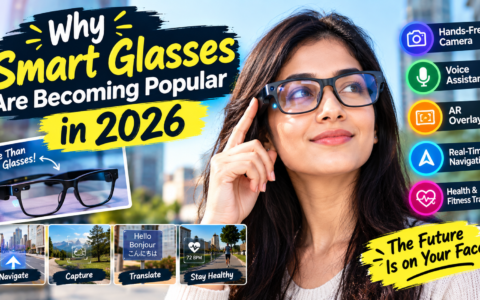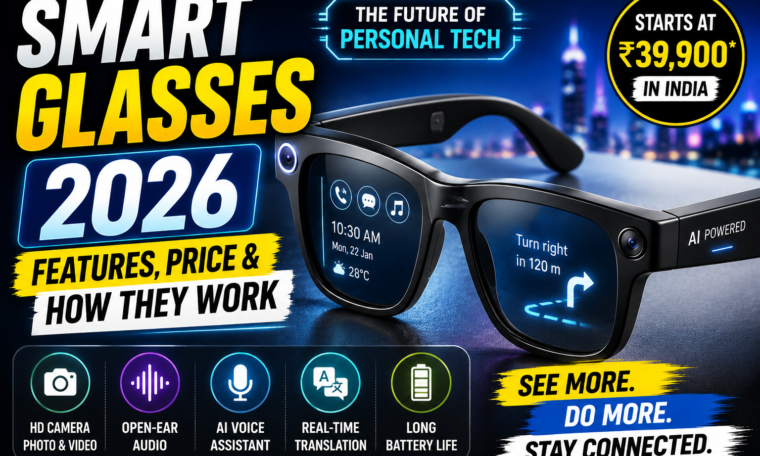
Smart glasses 2026 are quickly becoming one of the most interesting categories in wearable technology. What once looked like a futuristic concept is now becoming a practical consumer product, combining traditional eyewear with cameras, microphones, speakers, artificial intelligence and hands-free controls.
Unlike conventional glasses, smart glasses can help users take photos, record videos, listen to music, answer calls, interact with AI assistants and, depending on the model, receive information through built-in displays.
In India, the smart-glasses market is also expanding. The Ray-Ban Meta Gen 2 starts at ₹39,900, while performance-focused models such as the Oakley Meta Vanguard start at ₹52,300. Other smart-glasses models listed for the Indian market include products from Xiaomi, Solos, TCL and Samsung, although availability varies.
So, what exactly are smart glasses, how do they work and are they worth buying in 2026? Let’s explore.
What Are Smart Glasses?
Smart glasses are wearable electronic devices designed to look and function partly like ordinary glasses while adding digital capabilities.
Depending on the model, smart glasses can include:
- Cameras
- Open-ear speakers
- Microphones
- Bluetooth connectivity
- Wi-Fi
- Artificial intelligence
- Touch controls
- Voice commands
- Built-in displays
- Smartphone connectivity
However, not all smart glasses are the same.
Some are essentially AI-powered camera and audio glasses, while others are closer to augmented-reality devices with displays that can place digital information within your field of view.
This distinction is important when shopping for smart glasses.
How Do Smart Glasses Work?
The basic idea is surprisingly simple.
Smart glasses use miniature electronic components built into the frame and arms.
A camera can capture what you’re seeing. Microphones can listen to voice commands and conversations. Speakers can deliver music, calls or AI responses directly to your ears.
The glasses then communicate with a smartphone or other connected device through wireless technology.
AI-enabled models can go one step further.
For example, you might look at an object and ask the glasses to identify it. The camera captures the scene, the software processes the visual information and an AI assistant provides an answer.
This creates a more natural, hands-free interaction with technology.
Smart Glasses 2026: Key Features
The biggest selling point of modern smart glasses is that several technologies are combined into something that still resembles ordinary eyewear.
1. Built-In Camera
Many smart glasses now include cameras capable of capturing photos and video from a first-person perspective.
The Ray-Ban Meta Gen 2, for example, supports 3K video recording and upgraded capture capabilities. Meta says the second-generation model also offers improved battery life and additional camera features.
This can be particularly useful for travel, social-media content and hands-free photography.
Instead of taking out your smartphone, you can simply capture the moment from your own point of view.
2. Open-Ear Audio
Smart glasses can also function like wireless headphones.
Tiny speakers built into the frame allow users to listen to music, podcasts, navigation instructions and phone calls while keeping their ears relatively open to surrounding sounds.
This can be useful when walking, cycling or traveling.
The experience is different from traditional earbuds because you don’t have to place anything inside your ears.
3. AI Voice Assistant
AI is one of the biggest reasons smart glasses are attracting attention in 2026.
Users can interact with compatible assistants using voice commands.
You might ask a question, request information, control music or ask the glasses to describe something in front of you.
The exact capabilities vary between products and regions.
4. Hands-Free Photography
Imagine walking through a beautiful location and wanting to capture a moment.
Instead of reaching for your phone, you can use a voice command or physical control on the glasses.
This makes smart glasses particularly appealing to travelers, vloggers and people who want more natural first-person content.
5. Real-Time Translation
AI-powered translation is another important feature.
Compatible smart glasses can use microphones, cameras and AI software to help translate languages.
This could be particularly useful while traveling internationally.
Rather than constantly switching between different apps on your smartphone, users can potentially receive translated information through their glasses.
The quality and availability of translation depend on the specific model and software.
6. AI Vision
AI vision allows compatible glasses to understand visual information.
For example, you could ask:
“What am I looking at?”
The system can use the camera to analyze the scene and provide an answer.
Possible applications include identifying objects, reading signs, describing surroundings and answering questions about what the camera sees.
Researchers are also experimenting with more advanced always-on AI agents that combine real-world visual perception with task execution through smart glasses.
Smart Glasses vs AR Glasses: What’s the Difference?
This is one of the most important things consumers should understand.
Smart glasses do not necessarily have a display.
For example, Ray-Ban Meta glasses provide cameras, speakers, microphones and AI features but don’t work like a traditional heads-up AR display.
AR glasses, on the other hand, can place digital graphics or information directly into your field of vision.
So, when you hear “smart glasses,” don’t automatically assume you’ll see floating maps, notifications or virtual screens in front of your eyes.
The technology ranges from relatively simple AI audio glasses to much more advanced augmented-reality systems.
Smart Glasses Price in India 2026
The price of smart glasses varies significantly depending on their features.
The Ray-Ban Meta Gen 2 starts at ₹39,900 in India. The model offers AI features, a camera, open-ear audio and up to eight hours of battery life according to Meta.
The Oakley Meta Vanguard, designed with a stronger focus on athletes and outdoor users, starts at ₹52,300 in India. It features Meta AI, a 12MP camera and hands-free controls.
Other models listed for the Indian market cover a broader range. Smartprix’s July 2026 listing shows upcoming products ranging from around ₹12,999 to more than ₹50,000, although prices and availability can change.
This means consumers should check official availability and warranty coverage before purchasing.
Ray-Ban Meta Gen 2: A Major Smart-Glasses Option
The Ray-Ban Meta Gen 2 is one of the most prominent smart-glasses products available in India.
It combines the familiar Ray-Ban eyewear design with Meta’s technology.
Key features include:
- 3K Ultra HD video
- AI assistant
- Open-ear speakers
- Multiple frame styles
- Improved microphones
- Hands-free photography
- Voice controls
- Up to 8 hours of battery life
- Charging case with additional power
Meta launched the Gen 2 in India at ₹39,900 in December 2025.
The combination of recognizable eyewear and smart functionality makes this category particularly appealing to consumers who don’t want their wearable technology to look like a computer attached to their face.
Oakley Meta Vanguard for Sports
For people who spend more time outdoors, the Oakley Meta Vanguard takes a different approach.
The glasses are designed for athletes and outdoor activities.
They feature a more secure wraparound design, a centrally positioned 12MP camera and support for hands-free Meta AI interactions.
Meta has also positioned Oakley Meta glasses as performance-focused eyewear, with water resistance and open-ear speakers.
This demonstrates an important trend in 2026: smart glasses are becoming specialized rather than being designed for just one type of user.
Who Can Benefit From Smart Glasses?
Smart glasses aren’t necessarily useful for everyone.
However, several groups could benefit from them.
Travelers
Hands-free photos, translation and navigation can make travel easier.
Content Creators
First-person video can be captured without constantly holding a camera.
Cyclists and Athletes
Open-ear audio and hands-free controls can be useful during outdoor activities.
Students
AI assistance, audio information and hands-free research could become useful educational tools.
People Seeking Accessibility Features
Visual AI and audio descriptions can potentially help users interact with their surroundings in new ways.
The exact accessibility benefits depend heavily on the software and individual needs.
Are Smart Glasses Safe?
Smart glasses raise legitimate privacy questions because many models include cameras.
A tiny camera can make recording people easier and less obvious than holding a smartphone.
This has already generated public debate around Meta’s smart glasses, particularly concerning recording in public places and how people know when they are being filmed.
Users should respect local laws, privacy expectations and venue rules.
Manufacturers also need to make recording indicators clear and provide strong privacy controls.
For buyers, privacy should be treated as an important feature—not an afterthought.
Battery Life: What Should You Expect?
Battery life remains one of the biggest challenges for wearable technology.
A smart-glasses frame has very limited space for batteries compared with a smartphone.
The Ray-Ban Meta Gen 2 represents a significant improvement, with Meta claiming up to eight hours of battery life and a charging case providing additional power.
Actual battery life can vary depending on camera use, calls, music, AI features and connectivity.
Heavy camera and AI usage will generally consume more power.
Are Smart Glasses Worth Buying in 2026?
For some users, yes.
Smart glasses can be genuinely useful if you frequently take photos, travel, listen to audio or want hands-free access to AI.
However, they are not yet a complete replacement for smartphones.
A smartphone remains better for tasks requiring a large display, detailed editing, extensive typing and traditional apps.
Think of smart glasses as a companion device, rather than a replacement for your phone.
What to Check Before Buying Smart Glasses
Before purchasing, consider:
Camera Quality
Check photo and video resolution, stabilization and low-light performance.
AI Features
Make sure the AI functions available in your country are actually useful to you.
Battery Life
Look at real-world usage rather than only advertised maximum figures.
Audio Quality
Check speaker performance, microphone quality and call clarity.
Comfort
You’ll potentially wear these for hours, so weight and frame design matter.
Privacy
Understand how recordings and AI interactions are handled.
Prescription Support
If you wear prescription glasses, check whether prescription lenses are supported.
Warranty
Choose products with reliable local warranty and service support.
The Future of Smart Glasses
The next stage of smart glasses could be much more advanced.
Today’s AI glasses primarily provide audio responses and camera-based intelligence.
Future generations could combine AI with displays, spatial computing and more sophisticated sensors.
That could allow glasses to provide:
- Real-time navigation
- Live captions
- Visual notifications
- Contextual reminders
- Object information
- Personalized recommendations
- Augmented-reality experiences
Researchers are already exploring lightweight, low-power AI systems capable of processing visual information directly on wearable devices.
The ultimate goal is clear: technology that feels less like a device and more like a natural extension of the user.
Conclusion
Smart glasses 2026 are moving beyond the experimental stage and becoming increasingly practical wearable devices.
With cameras, open-ear speakers, AI assistants, voice controls, translation and visual understanding, today’s smart glasses can perform tasks that once required a smartphone.
The Indian market is also expanding, with products such as the Ray-Ban Meta Gen 2 and Oakley Meta Vanguard offering increasingly sophisticated features. Prices currently range from affordable upcoming models to premium devices costing more than ₹50,000.
However, smart glasses still have limitations. Battery life, privacy, AI accuracy, smartphone dependence and the absence of displays on many models mean they aren’t a replacement for smartphones or full AR glasses.
Still, the direction is exciting.
In 2026, smart glasses are becoming less about looking futuristic and more about making everyday technology hands-free. As AI becomes more capable and hardware becomes smaller, smart glasses could eventually become one of the most important wearable technologies of the next decade.