5-Star vs 3-Star AC: Which One Saves More Electricity?
When summer temperatures rise, the air conditioner often becomes one of the biggest electricity-consuming appliances in an Indian household. That’s why choosing between a 5-Star vs 3-Star AC isn’t just about the upfront price. The decision can directly affect your monthly electricity bill for years.
A 5-star air conditioner generally offers better energy efficiency than a comparable 3-star model. But does that automatically mean everyone should buy a 5-star AC?
Not necessarily.
The right choice depends on how many hours you use your AC, room size, cooling requirements, electricity tariff, AC capacity, climate and how long you plan to keep the appliance.
Let’s break down the difference between 3-star and 5-star ACs and find out which option can save you more electricity in 2026.
What Does the Star Rating of an AC Mean?
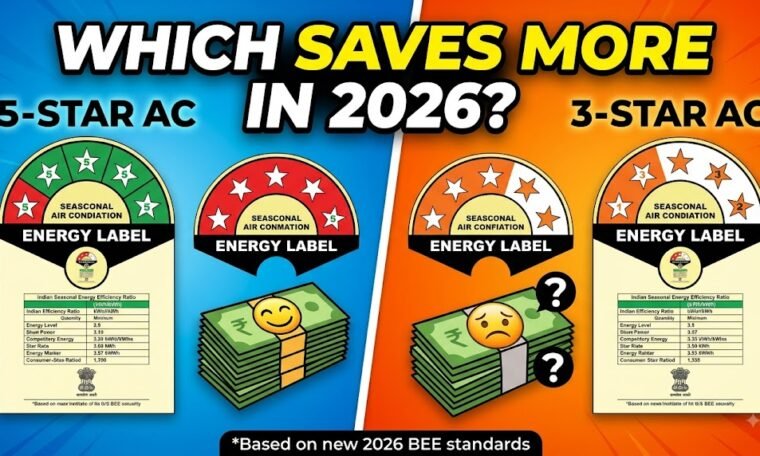
The star rating system in India is managed by the Bureau of Energy Efficiency (BEE).
The rating helps consumers understand the relative energy efficiency of appliances.
Generally:
- 1 Star: Lower efficiency
- 2 Star: Better than 1 Star
- 3 Star: Moderate efficiency
- 4 Star: High efficiency
- 5 Star: Highest efficiency within the applicable rating system
A 5-star AC is designed to deliver cooling with greater energy efficiency than a comparable 3-star AC.
However, the rating should not be interpreted as meaning a 5-star AC will consume exactly a particular percentage less electricity in every situation.
Actual consumption depends on how the AC is used.
5-Star AC vs 3-Star AC: The Main Difference
The biggest difference is energy efficiency.
A 3-star AC may have a lower purchase price, while a 5-star model typically costs more initially.
However, the 5-star model can potentially consume less electricity during operation.
Think of it like buying two cars. One may cost less at the showroom, while the other costs more but uses less fuel every time you drive it.
The same basic idea applies to energy-efficient ACs.
3-Star AC
- Usually lower upfront price
- Reasonable energy efficiency
- Suitable for moderate usage
- Can be attractive for occasional users
5-Star AC
- Usually higher upfront price
- Better energy efficiency
- Potentially lower running cost
- More attractive for frequent AC users
Which AC Uses Less Electricity?
In general, a 5-star AC uses less electricity than a comparable 3-star AC when operated under similar conditions.
But the exact difference depends on:
- AC capacity
- Compressor technology
- Room size
- Outdoor temperature
- Indoor temperature
- Usage hours
- Energy efficiency ratio
- Maintenance
- Insulation
- Door and window openings
This is why you should check the actual annual energy consumption displayed on the BEE label rather than choosing an AC solely because it says “5 Star.”
5-Star AC Electricity Consumption
The electricity consumption of an AC depends on its rated capacity and operating conditions.
For example, a 1.5-ton inverter AC does not necessarily consume the same electricity throughout the entire day.
An inverter compressor can adjust its operating speed based on cooling demand.
When the desired temperature is reached, the compressor can reduce its output instead of continuously running at maximum capacity.
This can make inverter technology particularly useful for households that operate their ACs for several hours every day.
3-Star AC Electricity Consumption
A 3-star AC can still be reasonably efficient.
If you only use an AC for a few hours occasionally, the difference in electricity savings between a 3-star and 5-star model may take longer to recover through lower electricity bills.
That’s where the purchase-price difference becomes important.
Suppose a 5-star model costs considerably more than a comparable 3-star model.
If you use your AC only occasionally, you may not generate enough electricity savings to quickly recover that additional upfront cost.
Example: How Usage Changes the Calculation
Imagine two similar 1.5-ton ACs:
- 3-star model: lower initial price
- 5-star model: higher initial price
If the AC runs for 8–10 hours every day, the difference in electricity consumption can become significant over a cooling season.
But if you run the AC for only 2–3 hours a day, the annual savings may be considerably smaller.
This is why there is no single answer to the question:
“How much money will a 5-star AC save?”
Your usage determines the result.
5-Star vs 3-Star AC: Which Is Better for Heavy Users?
If you use your AC heavily, a 5-star AC is generally the more attractive choice.
For example, heavy users may include:
- People working from home
- Families living in very hot regions
- Households running ACs overnight
- Homes with young children or elderly family members
- Businesses with frequent AC usage
If your AC runs for many hours every day, even modest improvements in efficiency can accumulate over months and years.
Which AC Is Better for Occasional Users?
A 3-star AC can make sense for occasional users.
If you only switch on the AC:
- During peak summer
- For a few hours at night
- On particularly hot days
- In a rarely used guest room
then the lower purchase price of a 3-star AC may be more attractive.
However, you should still compare the actual energy consumption figures before purchasing.
Does Inverter AC Save Electricity?
Inverter technology is one of the most important developments in modern air conditioners.
Traditional fixed-speed compressors generally operate at a fixed capacity and cycle on and off.
Inverter systems can vary compressor speed according to the cooling requirement.
Potential Benefits
- Better temperature control
- Efficient operation at partial loads
- Lower energy consumption under suitable conditions
- More consistent cooling
- Reduced temperature fluctuations
However, inverter technology doesn’t mean the AC will always use very little electricity.
If you set an extremely low temperature or use an oversized unit, consumption can still increase.
Room Size Matters More Than You Think
Choosing the right AC capacity is essential.
A small AC installed in a large room may have to work harder to maintain the desired temperature.
At the same time, installing an unnecessarily large AC isn’t automatically more efficient.
Room size, ceiling height, sunlight exposure, insulation, number of occupants and local climate should all be considered.
For many homes, a correctly sized AC can be more important than simply choosing between 3-star and 5-star ratings.
How Much Electricity Does an AC Consume?
A simple estimate can be made using:
Electricity consumption = Power × Time
If an appliance averages 1.2kW and runs for 5 hours:
1.2 × 5 = 6 kWh
If your electricity tariff were ₹8 per unit, the theoretical cost would be:
6 × ₹8 = ₹48
However, an inverter AC doesn’t necessarily draw its maximum rated power continuously.
Therefore, this is only a simplified example.
Your actual bill will depend on operating conditions and the AC’s efficiency.
How to Reduce Your AC Electricity Bill
Buying a 5-star AC is only one part of saving electricity.
Your daily habits matter enormously.
Set a Reasonable Temperature
Avoid setting the thermostat unnecessarily low.
A moderate temperature can reduce cooling demand.
Clean the Filters
Dirty filters restrict airflow and can make the system work harder.
Keep Doors and Windows Closed
Preventing cooled air from escaping can improve efficiency.
Use Curtains
Sunlight entering through windows can increase indoor heat.
Maintain the Outdoor Unit
Make sure the outdoor unit has adequate airflow and isn’t obstructed.
Use Sleep Mode
Many modern ACs offer sleep or energy-saving modes.
Use a Ceiling Fan
A fan can help circulate cooled air, allowing comfortable operation at a moderate thermostat setting.
5-Star vs 3-Star AC Price Difference
The purchase price varies by:
- Brand
- Capacity
- Inverter technology
- Model year
- Features
- Cooling technology
- Smart connectivity
In general, a 5-star AC can cost more than a comparable 3-star model.
But don’t look at only the purchase price.
Calculate:
Purchase price + electricity cost + maintenance + expected ownership period
A more expensive AC could become financially attractive if it delivers substantial energy savings over many years.
Should You Buy a 5-Star AC in 2026?
For many households, yes.
A 5-star AC is particularly worth considering if:
- You use AC daily
- You live in a hot climate
- You work from home
- You run the AC overnight
- Electricity costs are high
- You plan to keep the AC for several years
If your usage is very limited, however, a good 3-star inverter AC may provide better overall value.
5-Star vs 3-Star AC Comparison
| Feature | 3-Star AC | 5-Star AC |
|---|---|---|
| Energy efficiency | Good | Better |
| Initial price | Usually lower | Usually higher |
| Running cost | Generally higher | Generally lower |
| Best for | Moderate use | Frequent use |
| Long-term savings | Moderate | Potentially higher |
| Electricity consumption | Higher than comparable 5-star models | Lower than comparable 3-star models |
| Ideal buyer | Budget/occasional user | Heavy/frequent user |
Common Mistakes When Buying an AC
Many consumers focus only on star ratings.
That’s a mistake.
You should also check:
AC Capacity
Choose the correct tonnage for your room.
ISEER/Energy Information
Compare the efficiency information on the official energy label.
Annual Electricity Consumption
This gives you a more useful indication of potential energy use.
Warranty
Check compressor and product warranty separately.
Service Network
A reliable service network can reduce long-term ownership problems.
Noise Level
Especially important if you’re buying an AC for a bedroom.
Final Verdict: 5-Star vs 3-Star AC
So, 5-Star vs 3-Star AC—which one saves more electricity?
In general, a 5-star AC is the better choice for electricity savings when compared with a similar 3-star model operating under similar conditions.
However, that doesn’t automatically make it the best purchase for everyone.
If you use your AC heavily, the higher upfront price of a 5-star model can potentially be recovered through lower electricity consumption over time. For occasional users, a 3-star inverter AC may offer a better balance between purchase price and operating costs.
The smartest approach is to look beyond the star label. Compare annual electricity consumption, AC capacity, inverter technology, room size, usage hours, warranty and total ownership cost.
Most importantly, choose the correct AC size and maintain it properly. Even the most energy-efficient air conditioner can waste electricity if it’s oversized, poorly maintained or operated at unnecessarily low temperatures.