Smart Appliances vs Traditional Appliances: Which Is Better in 2026?
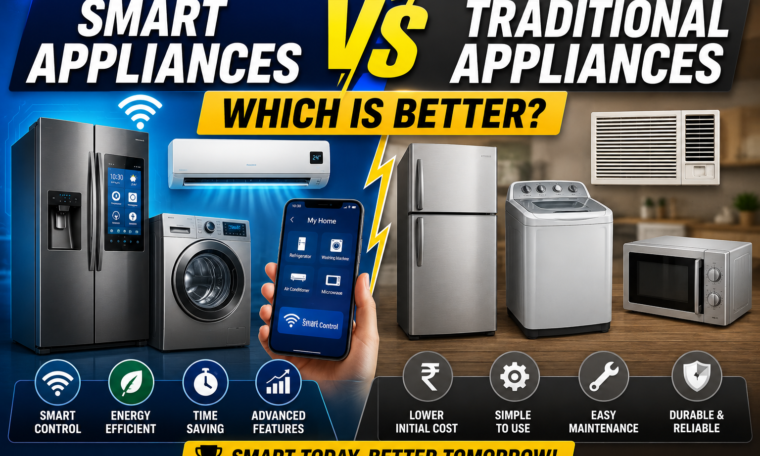
Smart appliances vs traditional appliances is an increasingly common debate as connected technology enters Indian kitchens, laundry rooms and living spaces.
A smart washing machine can connect to your phone. A smart refrigerator can send notifications. Smart air conditioners can be controlled remotely. Meanwhile, traditional appliances continue to perform their basic functions without Wi-Fi, apps or complicated software.
So which is better?
The answer depends on what you value most: convenience, simplicity, price, automation, energy efficiency or long-term reliability.
What Are Smart Appliances?
Smart appliances use technology such as sensors, software, Wi-Fi or Bluetooth to provide additional functionality.
Features may include:
- Smartphone control
- Automatic settings
- Remote notifications
- Voice commands
- Energy monitoring
- Diagnostic tools
- Scheduling
- AI-assisted operation
The exact features vary considerably.
What Are Traditional Appliances?
Traditional appliances focus primarily on their core functions.
A conventional refrigerator cools food.
A traditional washing machine washes clothes.
A standard microwave heats and cooks food.
These appliances generally don’t require internet connectivity or smartphone apps.
Smart Appliances: Main Advantages
Convenience
Automation is one of the biggest advantages.
A smart washing machine may notify you when a cycle finishes, while a connected AC can be turned on before you arrive home.
Remote Control
Smartphone control can be useful when you’re away from home.
Automation
Schedules and automatic settings can reduce repetitive tasks.
Monitoring
Some appliances provide information about energy consumption, maintenance or operation.
Smart Appliances: Disadvantages
Higher Initial Cost
Smart models often cost more than comparable traditional appliances.
More Technology Means More Complexity
Additional electronics can make products more complicated.
Internet Dependence
Some features may stop working when connectivity is unavailable.
However, not every smart appliance becomes completely unusable without internet. Some basic functions can continue locally, depending on the device.
Privacy Concerns
Connected devices may collect usage information.
Consumers should review privacy settings and use secure accounts.
Traditional Appliances: Advantages
Traditional appliances have one major strength: simplicity.
They don’t require an app.
They don’t need a Wi-Fi connection.
They generally don’t need software updates.
For consumers who simply want an appliance to perform its core function, this can be a significant advantage.
Traditional Appliances: Disadvantages
Traditional models usually provide less automation.
You may need to manually select settings, check the appliance physically and manage tasks yourself.
They may also lack advanced monitoring features.
Smart vs Traditional: Price Comparison
In general, smart appliances tend to cost more than comparable conventional models.
But the difference varies significantly depending on the category.
For example, adding connectivity to a basic appliance may cost relatively little, while premium AI-enabled technology can increase the price substantially.
The key is to compare total value, not simply the number of features.
Which Is Better for Indian Families?
It depends on your lifestyle.
Choose Smart Appliances If:
- You love automation
- You use smartphone controls regularly
- You want remote notifications
- You are building a connected home
- The additional features fit your budget
Choose Traditional Appliances If:
- You want simplicity
- You have a limited budget
- You don’t care about apps
- You prefer fewer electronic components
- You want straightforward operation
Are Smart Appliances More Energy Efficient?
Not automatically.
A smart appliance may include energy-management features, but energy consumption ultimately depends on the appliance’s design, efficiency rating and usage.
Don’t assume “smart” means “low electricity consumption.”
Always compare the relevant energy-efficiency information.
Which Is Easier to Repair?
Traditional appliances can sometimes be simpler to diagnose and repair because they contain fewer connected components.
However, reliability depends heavily on the brand, model and service network.
A smart appliance isn’t automatically unreliable, but repairs can involve additional electronic components.
Do Smart Appliances Become Obsolete?
This is an important consideration.
Software support may eventually end for some connected devices.
The physical appliance might continue working, but certain online or app-based features may no longer receive updates.
That’s why buyers should consider long-term support before spending heavily on connected appliances.
The Best Approach: A Mix of Both
You don’t have to choose one category for your entire home.
You could have a smart TV and traditional refrigerator.
Or a smart washing machine and conventional microwave.
Choose smart technology where it provides meaningful convenience and traditional technology where simplicity is more valuable.
Final Verdict
So, smart appliances vs traditional appliances—which is better?
Neither is universally better.
Smart appliances win on automation, connectivity and convenience.
Traditional appliances win on simplicity, straightforward operation and often lower upfront costs.
The smartest purchase is the appliance that performs its main job well and offers features you’ll actually use.
Don’t pay extra for technology simply because it sounds impressive.