Best Air Conditioners Under ₹40,000 in 2026
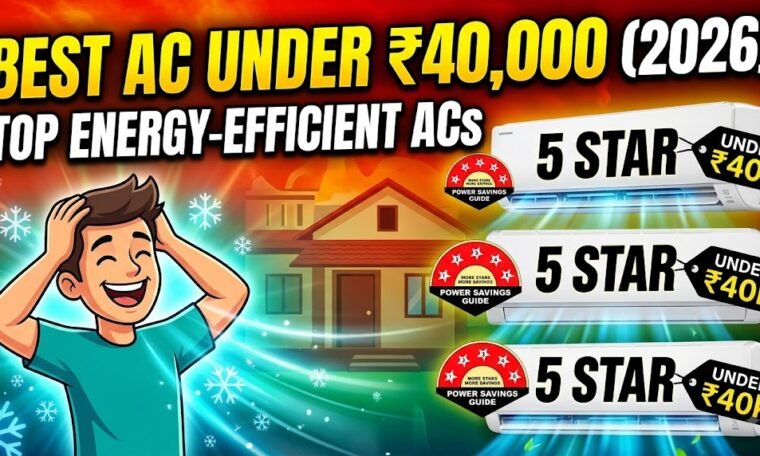
Summer in India can make an air conditioner feel less like a luxury and more like a necessity. But buying a new AC doesn’t mean you have to spend ₹50,000 or ₹60,000. The market in 2026 has several air conditioners under ₹40,000 that offer inverter technology, multiple cooling modes, copper condensers and useful energy-saving features.
Current listings show that shoppers can find 1.5-ton inverter ACs under ₹40,000, including 3-star and 4-star models, while some 5-star options are also available depending on sales and retailer pricing. For example, current listings show a Daikin 1.5-ton 4-star inverter model around ₹39,990, Samsung 1.5-ton 4-star models around ₹39,490, and several 1.5-ton 3-star models below ₹38,000.
This makes the ₹40,000 budget an interesting sweet spot for buyers who want a balance between price, cooling performance and electricity efficiency.
Why Buy an AC Under ₹40,000 in 2026?
The biggest advantage of this price segment is choice.
You don’t necessarily have to compromise on essential features simply because you’re shopping on a budget.
Many models around this range offer:
- Inverter compressors
- 3-star, 4-star or 5-star energy ratings
- Copper condensers
- Convertible cooling modes
- Turbo cooling
- Sleep modes
- Auto restart
- Dust filters
- Dehumidification
- Wi-Fi connectivity on selected models
- Multiple fan-speed settings
Current market listings also show several 2026 models priced below ₹40,000, although prices can change with sales, location and retailer offers.
1.5 Ton AC vs 1 Ton AC: Which Should You Buy?
Before choosing a specific model, you need to select the right capacity.
A 1-ton AC can be suitable for smaller rooms, while a 1.5-ton AC is commonly considered for medium-sized rooms, depending on factors such as room dimensions, sunlight, ceiling height and insulation.
Current retailer listings commonly associate 1.5-ton models with rooms around 130–180 sq. ft., although actual requirements vary by home and climate.
Don’t choose an AC simply because a larger capacity sounds better.
An oversized or undersized AC can affect comfort and efficiency.
Best ACs Under ₹40,000: What to Look For
Instead of focusing only on brand names, compare the following specifications.
Energy Rating
A higher BEE rating generally indicates better efficiency within the applicable rating framework.
Inverter Technology
An inverter compressor can vary its output according to cooling demand, potentially improving efficiency during longer operation.
Annual Energy Consumption
This is one of the most useful numbers to compare.
Copper Condenser
Copper-based heat exchangers are common in many models and can offer good heat-transfer performance.
Convertible Cooling
This allows users to adjust cooling capacity according to their needs.
Warranty
Check the comprehensive, PCB and compressor warranties separately.
Some Strong AC Options Around ₹40,000
Because AC prices change frequently, the following should be treated as examples of models currently appearing around the ₹40,000 budget, rather than permanent prices.
Daikin 1.5 Ton 4-Star Inverter AC
A current 2026 listing shows a Daikin 1.5-ton 4-star inverter AC at around ₹39,990, with listed annual power consumption of approximately 751.22 kWh and a recommended room size of 130–180 sq. ft.
This makes it interesting for buyers who want to stay below ₹40,000 while prioritising energy efficiency.
Samsung 1.5 Ton 4-Star Inverter AC
Samsung also has 1.5-ton 4-star inverter models appearing around the ₹40,000 mark.
One current listing shows a 2026 Samsung Bespoke AI 1.5-ton 4-star model at around ₹39,490, with listed annual power consumption of approximately 713.57 kWh.
The model also includes features such as Wi-Fi connectivity and energy-saving functions.
Blue Star 1.5 Ton 3-Star Inverter AC
For buyers who want a mainstream 1.5-ton inverter AC without moving toward the ₹40,000 ceiling, a Blue Star 2026 1.5-ton 3-star inverter model is currently listed around ₹35,490.
Its listed annual power consumption is around 918.45 kWh, illustrating why buyers should compare energy-consumption figures rather than looking only at the purchase price.
LG 1.5 Ton 3-Star Smart Inverter AC
An LG 1.5-ton 3-star 2026 model is currently listed around ₹35,490 and has listed annual energy consumption of approximately 769.6 kWh.
The model includes smart features, convertible cooling functionality and multiple cooling modes.
Panasonic 1.5 Ton 3-Star Inverter AC
A Panasonic 1.5-ton 3-star 2026 model is currently listed around ₹36,990, with listed annual consumption of approximately 877.74 kWh.
Panasonic models in this segment can appeal to buyers looking for smart connectivity and air-quality-related features.
Samsung 1.5 Ton 5-Star Inverter AC
If energy efficiency is your priority, it is possible to find 5-star 1.5-ton ACs around or below ₹40,000 during certain sales.
For example, Reliance Digital currently lists a Samsung 1.5-ton 5-star inverter model at approximately ₹37,990.
However, prices and stock can change quickly, so always verify the current listing before purchasing.
Should You Buy a 5-Star AC Under ₹40,000?
If you use your AC for several hours every day, a 5-star model can be worth considering.
The higher energy rating may help reduce electricity consumption compared with a lower-rated comparable model.
But there’s an important catch.
Don’t compare star ratings alone.
Look at:
Annual electricity consumption + purchase price + expected usage.
A 5-star AC that costs ₹40,000 may not necessarily be a better financial decision than a 3-star model costing ₹33,000 if you only use the AC occasionally.
For heavy users, however, energy savings can become more meaningful over several years.
Why Inverter ACs Are Popular in 2026
Inverter ACs have become increasingly common because they can adjust compressor operation according to cooling requirements.
Instead of constantly operating at full capacity, the compressor can reduce its output once the room approaches the desired temperature.
This can provide:
- More consistent cooling
- Potential energy savings
- Reduced temperature fluctuations
- Quieter operation in suitable conditions
- Better comfort during longer usage
However, actual electricity consumption depends on temperature settings, outdoor heat, room insulation, usage duration and maintenance.
Convertible AC: Is It Worth Paying For?
Many ACs under ₹40,000 now advertise convertible cooling.
This feature allows users to adjust the cooling capacity according to the requirement.
For example, you may not need maximum cooling when only one person is in the room.
Reducing capacity can potentially help control energy consumption.
Convertible modes can therefore be particularly useful for households that want flexibility.
What About ACs for Very Hot Indian Summers?
If you live in a city where summer temperatures become extremely high, cooling performance at high ambient temperatures should be an important consideration.
Some current budget AC listings specifically advertise operation at very high outdoor temperatures. For example, certain Haier models listed under ₹40,000 advertise cooling performance in extreme heat.
Before purchasing, check the manufacturer’s specifications for the actual model rather than assuming that every AC performs equally in extreme heat.
Split AC vs Window AC Under ₹40,000
You can find both types within this budget.
Split AC
Advantages:
- Generally quieter indoor operation
- Better aesthetics
- Suitable for bedrooms and living rooms
- Wide selection of inverter models
Disadvantages:
- Installation can cost more
- Requires wall space and outdoor-unit placement
Window AC
Advantages:
- Usually simpler installation
- Can be cheaper
- Compact installation requirements
Disadvantages:
- Typically noisier
- Requires a suitable window opening
- Fewer premium inverter options
For a bedroom or living room, many buyers prefer a split inverter AC.
How Much Electricity Will an AC Under ₹40,000 Use?
There is no single answer.
An AC’s consumption depends on its rated power, efficiency and operating conditions.
A simplified calculation is:
Electricity Used = Average Power Consumption × Operating Hours
For example, if an AC averages 1 kW and operates for five hours:
1 kW × 5 hours = 5 kWh
At an electricity rate of ₹8 per unit, that would theoretically equal ₹40 for that period.
However, this is only an illustration. Inverter ACs can vary their power consumption, so actual usage can be substantially different.
How to Reduce Your AC Electricity Bill
Even the best energy-efficient AC can consume a lot if used incorrectly.
Set a Reasonable Temperature
Avoid unnecessarily low thermostat settings.
Clean Filters Regularly
Dirty filters can restrict airflow and reduce cooling efficiency.
Keep Doors and Windows Closed
Prevent cooled air from escaping.
Use Curtains
Direct sunlight can increase indoor heat.
Maintain the Outdoor Unit
Ensure sufficient airflow around the outdoor unit.
Use Sleep Mode
This can help optimise cooling overnight on supported models.
Use a Ceiling Fan
A fan can distribute cool air throughout the room and improve comfort.
AC Buying Mistakes to Avoid
Choosing the Wrong Capacity
Don’t buy a 1.5-ton AC simply because it’s more powerful.
Ignoring Annual Energy Consumption
A star rating isn’t the only efficiency indicator.
Forgetting Installation Costs
The advertised AC price may not include every installation-related charge.
Ignoring Service Availability
A cheaper AC isn’t necessarily a better long-term purchase if service support is poor in your area.
Buying Only on Discount
A large discount doesn’t automatically make an AC a good deal.
What Is the Best AC Under ₹40,000 in 2026?
There isn’t one universal winner.
If you want higher energy efficiency, look for a 4-star or 5-star inverter model when available within your budget.
If you’re prioritising features, smart Wi-Fi, convertible cooling and advanced air filters may be useful.
For value, a good 1.5-ton 3-star inverter AC can offer a compelling balance.
For small bedrooms, a 1-ton model may be more appropriate than a 1.5-ton unit.
Current market listings demonstrate that the ₹40,000 category includes options from brands such as LG, Samsung, Daikin, Panasonic, Blue Star, Voltas and others
Final Verdict
The best air conditioners under ₹40,000 in 2026 offer an attractive combination of cooling performance, energy efficiency and modern features. Buyers can now find several 1.5-ton inverter models in this budget, including 3-star, 4-star and, during some promotions, 5-star options.
If your priority is low electricity consumption, focus on a higher-rated inverter AC and compare the annual energy-consumption figure. If you want value for money, a 3-star inverter model may be sufficient. For smaller rooms, don’t overspend on a 1.5-ton AC when a properly sized 1-ton model could do the job.
Most importantly, don’t choose an AC solely because of its discount or star rating. Compare capacity, annual power consumption, inverter technology, cooling performance, warranty, installation cost and service network.