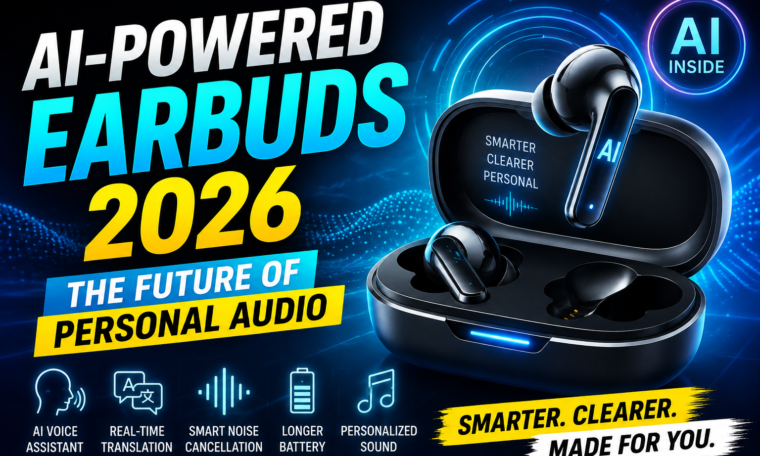
AI-powered earbuds 2026 are changing the way people think about personal audio. Wireless earbuds are no longer limited to playing music, answering calls and blocking outside noise. With artificial intelligence becoming a bigger part of consumer electronics, the latest earbuds are evolving into smart assistants that can understand voice commands, translate conversations, summarize information and provide more personalized audio experiences.
From AI-enhanced noise cancellation to real-time translation and smarter voice assistants, AI earbuds are becoming one of the most interesting technology trends of 2026. As manufacturers continue adding advanced processors and AI software to compact earbuds, the line between traditional headphones and intelligent wearable devices is becoming increasingly blurred.
What Are AI-Powered Earbuds?
AI-powered earbuds are wireless audio devices that combine traditional earbud technology with artificial intelligence.
A conventional pair of wireless earbuds may provide Bluetooth connectivity, microphones, music playback and noise cancellation. AI-powered models add software and processing capabilities that allow them to perform more advanced tasks.
Depending on the model, AI features can include:
- Voice-based AI assistants
- Real-time language translation
- Smarter noise cancellation
- Personalized sound
- Call-quality enhancement
- Voice isolation
- Audio transcription
- Context-aware assistance
- Gesture and voice controls
In simple terms, AI turns earbuds from audio accessories into intelligent personal devices.
Why AI Earbuds Are Trending in 2026
The growing popularity of AI-powered earbuds is part of a much larger shift toward AI-enabled consumer electronics.
Smartphones, laptops, watches and glasses are increasingly incorporating AI features. Earbuds are a natural extension of this trend because they are already worn throughout the day and contain microphones, speakers and wireless connectivity.
Instead of reaching for a phone every time you need information, AI earbuds can potentially allow you to interact with digital assistants directly through your ears.
This creates a more hands-free technology experience.
1. Real-Time Translation Is a Major Feature
One of the most exciting applications of AI earbuds is real-time language translation.
Imagine having a conversation with someone who speaks another language. Instead of repeatedly checking a translation app on your phone, compatible earbuds could help translate spoken language through your ears.
AI can analyze speech, recognize the language and generate a translated version.
Although translation accuracy can vary depending on the language, background noise and software, improvements in AI are making this technology increasingly practical.
For international travelers, students and business professionals, this could become one of the most valuable earbud features.
2. Smarter Noise Cancellation
Noise cancellation is already common in premium wireless earbuds, but AI can make the technology more adaptive.
Traditional active noise cancellation generally works by using microphones to detect external sounds and generate opposing signals.
AI-powered systems can take this further by analyzing the surrounding environment and adapting the audio experience.
For example, earbuds could recognize whether you’re:
- On an airplane
- Walking on a busy street
- Working in an office
- Sitting in a café
- Traveling by train
The system could then adjust noise reduction according to the environment.
This makes AI noise cancellation more intelligent rather than simply stronger.
3. AI Can Improve Voice Calls
Phone calls are another area where AI-powered earbuds can make a significant difference.
Background noise can make conversations difficult when you’re in crowded locations.
AI algorithms can analyze incoming microphone signals and distinguish between your voice and surrounding sounds.
This can help improve:
- Voice clarity
- Background-noise reduction
- Speech isolation
- Call quality
For people who frequently attend online meetings or take calls while traveling, this feature can be especially useful.
4. Personalized Audio Experiences
Everyone hears music differently, and everyone has different preferences.
AI can potentially analyze listening habits and adjust sound accordingly.
Instead of manually changing equalizer settings, an AI system could learn whether you prefer stronger bass, clearer vocals or brighter high frequencies.
Some systems may also adapt audio based on the environment.
For example, your preferred music settings at home might differ from what works best in a noisy outdoor environment.
This creates a more personalized listening experience.
5. AI Voice Assistants Become More Useful
Voice assistants have been available in wireless earbuds for years, but generative AI could make these interactions more natural.
Instead of relying only on simple commands such as “play music” or “call Mom,” users could potentially ask more conversational questions.
For example:
“Summarize the message I just received.”
“What is the weather going to be like this afternoon?”
“Remind me to call my friend at 7 PM.”
“Translate this sentence into Spanish.”
The usefulness of these features depends on the AI software, smartphone integration and privacy settings available with each product.
6. AI-Powered Audio Summaries
Another emerging possibility is audio summarization.
AI can process large amounts of spoken information and produce shorter summaries.
This could be useful for:
- Meetings
- Lectures
- Interviews
- Podcasts
- Voice notes
Imagine listening to a long meeting and receiving a concise summary of the key points afterward.
Instead of spending hours reviewing every sentence, AI could help identify the most important information.
7. AI Earbuds for Students
Students could become one of the biggest audiences for AI-powered earbuds.
Educational applications could include language learning, lecture transcription, pronunciation assistance and personalized study support.
For example, students learning a foreign language could use AI-assisted translation and pronunciation features while traveling or practicing conversations.
However, students should also be aware of academic policies. AI tools should support learning rather than be used to bypass examination or assignment rules.
8. AI Earbuds for Travelers
Travel is another area where AI earbuds could make a major difference.
A single pair of earbuds could potentially combine:
Music + Navigation + Translation + Calls + Voice Assistance
Instead of constantly pulling out a smartphone, travelers could use voice interactions for basic tasks.
This could make airports, public transportation and unfamiliar cities easier to navigate.
Translation is particularly interesting because communication barriers can make international travel challenging.
9. Better Battery Management Through AI
AI isn’t only about flashy features.
It can also potentially make earbuds more efficient.
Smart power management can analyze usage patterns and adjust energy consumption.
For example, earbuds may reduce certain background processes when battery levels become low or optimize performance depending on whether you’re listening to music, making calls or using an AI feature.
Better energy management could help manufacturers balance advanced AI functions with battery life.
10. AI and Hearing Personalization
Personalized sound is becoming increasingly important.
AI could analyze how users interact with different frequencies and adjust audio accordingly.
Some future systems may provide more advanced hearing personalization, helping users create sound profiles tailored to their individual listening preferences.
However, AI earbuds should not automatically be considered medical hearing devices.
Anyone experiencing hearing difficulties should seek advice from an appropriate healthcare professional rather than relying solely on consumer electronics.
AI Earbuds vs Traditional Wireless Earbuds
The biggest difference is intelligence.
| Feature | Traditional Wireless Earbuds | AI-Powered Earbuds |
|---|---|---|
| Music playback | Yes | Yes |
| Bluetooth | Yes | Yes |
| Noise cancellation | Some models | Advanced/adaptive options |
| Voice assistant | Basic | More conversational |
| Translation | Limited | Increasingly advanced |
| Personalized audio | Basic | AI-assisted |
| Audio summaries | Usually unavailable | Emerging feature |
| Context awareness | Limited | Potentially stronger |
The distinction will likely become less obvious as AI features become standard across the wireless-earbud market.
Privacy Is an Important Concern
With greater intelligence comes greater responsibility.
AI earbuds may rely on microphones and cloud-based services to process voice commands, conversations or other information.
That creates legitimate privacy questions.
Before buying AI-powered earbuds, consumers should understand:
- What data is collected
- Where audio is processed
- Whether recordings are stored
- How long data is retained
- Whether cloud processing is required
- Which permissions the companion app needs
A powerful AI feature is useful only if users are comfortable with how their information is handled.
Are AI-Powered Earbuds Worth Buying in 2026?
For someone who only wants music and occasional calls, a traditional pair of quality wireless earbuds may still be perfectly adequate.
But AI-powered earbuds become more interesting if you regularly use:
- Voice assistants
- Translation
- Online meetings
- Travel tools
- Personalized audio
- Hands-free technology
The decision ultimately depends on whether the AI features provide genuine everyday value.
Consumers should avoid paying a premium simply because a product has the word “AI” attached to it.
What Could AI Earbuds Do in the Future?
The technology is still developing.
Future AI earbuds could potentially become even more context-aware.
They might recognize what you’re doing and provide assistance accordingly.
For example, an AI earbud could understand that you’re entering a meeting and automatically adjust audio settings, or recognize that you’re traveling and make translation tools easier to access.
More advanced integration with smartphones, smartwatches, glasses and other connected devices could create an entire AI-powered personal ecosystem.
The earbud may eventually become one of the most convenient interfaces for interacting with that ecosystem.
How to Choose AI-Powered Earbuds in 2026
If you’re considering buying AI earbuds, don’t focus exclusively on AI.
Also check:
Sound Quality
Look for clear vocals, balanced audio and suitable bass response.
Battery Life
AI features can consume additional power, so battery performance matters.
Microphone Quality
Good microphones are essential for calls and voice commands.
Noise Cancellation
Check whether the earbuds offer effective ANC and useful transparency modes.
AI Features
Make sure the AI functions are genuinely useful to you.
Device Compatibility
Some features may work better with particular smartphones or operating systems.
Privacy Controls
Read the manufacturer’s privacy information before enabling voice-based AI services.
The Future of Personal Audio
The biggest change coming from AI-powered earbuds 2026 may not be better music quality.
It may be the transformation of earbuds into an everyday computing interface.
Your phone currently acts as the center of your digital life. But AI earbuds could allow users to access information without constantly looking at a screen.
That shift could make technology more natural and less visually demanding.
Instead of opening an app, typing a question and reading a result, you may simply ask your earbuds and hear the answer.
Conclusion
AI-powered earbuds 2026 represent an important step in the evolution of personal audio. With features such as adaptive noise cancellation, AI-enhanced calls, real-time translation, personalized sound and conversational voice assistants, earbuds are becoming much more than devices for listening to music.
The technology still has limitations, particularly around battery life, privacy, connectivity and AI accuracy. However, the direction is clear: earbuds are becoming smarter, more personalized and increasingly integrated into everyday digital life.
For consumers, the best approach is to look beyond the AI label and evaluate whether the features actually solve a problem. If manufacturers can combine reliable audio quality, useful AI capabilities, strong battery life and responsible data practices, AI earbuds could become one of the defining personal technology products of 2026 and beyond.