Introduction
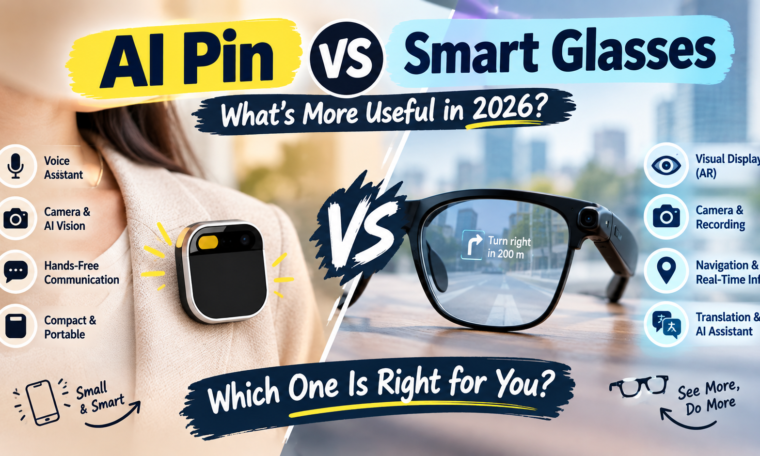
The AI Pin vs Smart Glasses comparison has become an interesting part of the wearable technology conversation in 2026. AI is moving beyond smartphones, and companies are exploring new ways to put digital assistants directly into everyday life.
AI pins and smart glasses take very different approaches. An AI pin is designed to act as a small wearable assistant that you can interact with through voice, touch, cameras, and other sensors. Smart glasses, meanwhile, place technology directly on your face and can combine cameras, speakers, microphones, and, in some models, visual displays.
Both concepts sound futuristic. However, which one is actually more useful for everyday life?
The answer depends on how you communicate, work, travel, consume information, and interact with technology. Let’s compare AI pins and smart glasses across the features that matter most.
What Is an AI Pin?
An AI pin is a wearable device designed to provide smartphone-like assistance without requiring a traditional screen.
Instead of constantly looking down at a phone, users can interact with the device through voice commands and other controls. Depending on the product, an AI pin may include a camera, microphone, speaker, sensors, and AI-powered software.
The concept focuses heavily on hands-free interaction.
For example, users could ask questions, send messages, receive information, or interact with an AI assistant without taking a smartphone out of their pocket.
However, the usefulness of an AI pin depends heavily on its software, battery life, connectivity, and ability to perform tasks reliably.
What Are Smart Glasses?
Smart glasses are wearable devices designed to add technology to ordinary eyewear.
Some models focus mainly on audio, cameras, microphones, and AI assistants. Other products include displays that can place digital information within the user’s field of view.
Smart glasses can therefore offer a more visual experience than an AI pin.
Imagine walking through a new city while receiving navigation information without constantly checking your phone. Another example would be capturing a first-person video while keeping both hands free.
The exact experience depends on the model because smart glasses range from simple connected eyewear to advanced augmented-reality devices.
AI Pin vs Smart Glasses: Main Difference
The biggest difference comes down to how you interact with information.
An AI pin generally focuses on voice-first, screen-free interaction. You ask the device something, and it responds through audio or another output method.
Smart glasses can also support voice interaction, but they have an additional advantage on models equipped with displays: information can appear directly in front of your eyes.
That difference can influence everything from navigation to notifications.
A person who prefers minimal visual distraction may appreciate a screen-free AI wearable. Someone who wants hands-free visual information may find smart glasses more practical.
AI Assistant Features
Artificial intelligence is central to both categories.
AI pins are designed around the idea of having a personal assistant available throughout the day. Users can potentially ask questions, create reminders, summarize information, or perform other tasks through natural language.
Smart glasses are also becoming increasingly connected to AI assistants. Voice commands can help users answer questions, identify objects, interact with content, or perform everyday tasks depending on the device.
The major difference is not necessarily the AI itself. Instead, the way the AI fits into the hardware experience matters.
Smart glasses can combine AI with a camera and audio system while keeping the user’s hands free.
Camera and Visual AI
Cameras give wearable AI devices another important capability.
An AI pin can use its camera to understand visual information and potentially answer questions about what the user is seeing.
Smart glasses take this concept further by placing the camera at eye level.
That setup can make first-person photography and video capture extremely natural. Users can record moments without holding a smartphone.
Visual AI could also help with recognizing objects, reading information, or understanding surroundings on supported devices.
Privacy remains an important consideration whenever a wearable camera is involved.
Navigation and Travel
Travel is one area where smart glasses can have a clear advantage, especially when a model includes a display.
Instead of repeatedly looking down at a smartphone for directions, users could potentially receive information while keeping their attention on their surroundings.
AI pins can also provide navigation instructions through voice.
That approach can be useful because it does not require a visual display. However, audio-only navigation may not provide the same visual context as display-equipped smart glasses.
Frequent travelers should therefore consider whether they prefer spoken directions or information displayed within their field of view.
Hands-Free Communication
Both devices can reduce the need to hold a smartphone.
An AI pin can allow users to interact through voice commands, while smart glasses can combine microphones, speakers, cameras, and AI assistants.
For quick messages or calls, either device could be convenient.
Smart glasses may feel more natural for communication because they resemble an everyday wearable rather than a separate gadget that needs to be attached to clothing.
Still, comfort and personal preference play a major role.
Battery Life
Battery life remains one of the biggest challenges for AI wearables.
Cameras, microphones, wireless connections, AI processing, and displays can consume significant energy.
AI pins may benefit from having fewer display-related power demands. Nevertheless, continuous AI interaction and cellular or wireless connectivity can still affect battery life.
Smart glasses face their own challenges. Camera use, speakers, microphones, AI processing, and displays can all contribute to power consumption.
Consequently, buyers should check real-world battery performance rather than relying only on advertised specifications.
Privacy Concerns
Privacy is a major issue for both AI pins and smart glasses.
A wearable camera can capture people, places, conversations, and surroundings without the user holding a traditional camera.
Smart glasses can therefore raise questions about whether people nearby know they are being recorded.
AI pins may create similar concerns if they include cameras or always-available microphones.
Users should understand recording indicators, privacy controls, data-processing policies, and cloud requirements before purchasing an AI wearable.
Responsible use also matters. Recording people or private spaces without appropriate permission can create social and legal problems depending on the situation.
Comfort and Convenience
A wearable device needs to be comfortable enough for everyday use.
AI pins can attach to clothing, making them relatively unobtrusive. However, users may need to interact with the device through voice or touch.
Smart glasses have an advantage because glasses are already a familiar wearable format for many people.
At the same time, adding cameras, batteries, speakers, and electronics can make smart glasses heavier than traditional eyewear.
Comfort should therefore be tested rather than judged purely from specifications.
AI Pin vs Smart Glasses for Work
Work requirements can change the comparison.
An AI pin may be useful for quick voice notes, reminders, information requests, and hands-free interactions.
Smart glasses could be more useful for professionals who benefit from visual information while keeping their hands occupied.
For example, technicians, warehouse workers, field professionals, or other hands-on workers may eventually benefit from wearable displays that provide instructions without requiring a phone or tablet.
The best option depends on the type of work and the software ecosystem supporting the device.
AI Pin vs Smart Glasses for Content Creators
Content creators may find smart glasses particularly interesting.
A camera positioned near the eyes can capture a natural first-person perspective. That setup can be useful for travel videos, tutorials, daily-life content, and behind-the-scenes footage.
AI pins can also support content workflows through voice commands, note-taking, or AI assistance.
Creators should consider camera quality, stabilization, storage, battery life, audio quality, and ease of transferring content before choosing a device.
Which Is Easier to Use?
Ease of use depends on the individual.
AI pins may appeal to people who want a simple, voice-first interface without another screen. Smart glasses can provide a more familiar combination of voice, audio, camera, and potentially visual information.
Someone who dislikes wearing glasses may prefer an AI pin. On the other hand, people already comfortable with eyewear may find smart glasses easier to integrate into daily routines.
The learning curve should also be considered. A wearable becomes useful only when its controls feel natural.
AI Pin vs Smart Glasses Comparison
| Feature | AI Pin | Smart Glasses |
|---|---|---|
| Voice Assistant | Yes | Yes |
| Camera | Available on some devices | Common on advanced models |
| Audio | Yes | Yes |
| Visual Display | Usually limited or absent | Available on some models |
| Hands-Free Use | Yes | Yes |
| AI Interaction | Core feature | Increasingly common |
| Navigation | Voice-based options | Audio and visual options on some models |
| First-Person Recording | Possible | Strong use case |
| Notifications | Audio/other feedback | Audio and visual on some models |
| Privacy Concerns | Moderate to high | Moderate to high |
| Battery Challenges | Yes | Yes |
| Everyday Wearability | Clothing-mounted | Eyewear-based |
Features vary significantly between individual products, so specifications should be checked before buying.
What Is More Useful in 2026?
There is no single answer for every user.
An AI pin may make more sense for someone who wants a compact, screen-free assistant. Voice commands, quick questions, reminders, and hands-free interactions can be its main strengths.
Smart glasses can offer a broader experience when they combine cameras, speakers, AI, and displays. The ability to capture photos, interact with an assistant, and potentially view information without holding a phone can make them appealing for travel and everyday tasks.
Your lifestyle should therefore guide the decision.
What to Look for Before Buying an AI Wearable
Before purchasing an AI wearable, consider these factors:
- AI assistant capabilities
- Battery life
- Camera quality
- Audio performance
- Display availability
- Smartphone compatibility
- Cellular or Wi-Fi requirements
- Privacy controls
- Data-processing policies
- Comfort
- Weight
- Subscription requirements
- Repair and replacement options
- Software update support
Price alone should not determine the choice. A cheaper wearable may become less useful if important AI features require additional subscriptions or services.
The Future of AI Wearables
AI wearables are still evolving.
Future devices may become smaller, more capable, and better integrated with smartphones and cloud services. Improvements in battery technology could also make continuous AI interaction more practical.
Smart glasses may eventually combine advanced displays with powerful AI assistants. Meanwhile, screen-free wearables could become more natural through improved voice recognition and contextual intelligence.
The long-term direction is clear: technology is gradually moving away from requiring users to constantly look at a smartphone.
Final Thoughts
The AI Pin vs Smart Glasses comparison highlights two different approaches to wearable computing.
AI pins focus on compact, voice-first interaction. Smart glasses combine wearable computing with audio, cameras, AI, and, in some cases, visual displays.
For voice-based assistance and minimal screens, an AI pin may fit certain lifestyles. People interested in hands-free photography, travel, visual information, and immersive interaction may find smart glasses more appealing.
Before buying either device, look beyond the AI marketing. Check battery life, comfort, privacy, compatibility, software support, and the features you will actually use.
In 2026, the most useful AI wearable is ultimately the one that fits naturally into your daily routine rather than the one with the longest feature list.