Best AI Gadgets You Can Buy in 2026
Artificial intelligence has moved beyond chatbots and smartphone apps. In 2026, AI is becoming part of the physical gadgets people use every day.
From smart glasses and AI earbuds to intelligent home appliances, these devices aim to make everyday tasks faster and easier. Some products focus on productivity, while others target entertainment, fitness or home automation.
The growing number of AI gadgets also creates a new problem: which devices are actually worth buying?
A gadget should do more than display an “AI-powered” label. It should solve a real problem, save time or offer a useful feature that traditional devices cannot provide as easily.
Here are some of the best AI gadgets you can buy in 2026 and the reasons they deserve attention.
1. AI Smart Glasses
AI smart glasses have quickly become one of the most exciting wearable technology categories.
Instead of reaching for your smartphone, you can use voice commands to interact with an AI assistant. Depending on the model, these glasses can also support photography, calls, music, translation and other hands-free features.
The latest Ray-Ban Meta-style smart glasses demonstrate how familiar eyewear can combine cameras, microphones, speakers and AI assistance.
Why Buy AI Earbuds?
They can be particularly useful for:
- Making calls
- Using voice assistants
- Travelling
- Listening to translated conversations
- Attending online meetings
- Controlling music hands-free
Noise cancellation remains important as well. A strong combination of audio quality, battery life and AI features provides better value than AI functionality alone.
5. AI Meeting Recorders
Professionals and students can benefit significantly from AI-powered recording devices.
These compact gadgets can record conversations and use AI software to create transcripts, summaries and organised notes. Instead of manually reviewing a lengthy meeting, users can quickly find the main points.
An AI recorder can prove especially useful for journalists, students, content creators and office professionals.
Common Uses Include:
- Business meetings
- Interviews
- Lectures
- Research
- Content planning
- Project discussions
Always make sure you have the appropriate consent before recording another person.
6. AI Robot Vacuum Cleaners
Smart cleaning technology has also received an AI upgrade.
Traditional robot vacuums can already map rooms and follow programmed routes. AI-powered models can take the process further by recognising objects, identifying obstacles and adjusting cleaning behaviour.
Imagine your robot recognising a cable on the floor instead of repeatedly getting stuck on it. That small improvement can make automated cleaning much more practical.
Why Consider an AI Robot Vacuum?
These devices can help with:
- Automated cleaning
- Room mapping
- Obstacle recognition
- Scheduled cleaning
- Area-specific cleaning
- Reduced daily household work
For busy households, this may be one of the most useful AI applications available today.
7. AI Security Cameras
Home security cameras are another area where AI can provide genuine benefits.
Instead of sending an alert every time something moves, intelligent cameras can attempt to identify different types of activity. Some systems can distinguish between people, vehicles and animals.
As a result, homeowners may receive fewer unnecessary notifications.
What Should You Check Before Buying?
Pay attention to:
- Video quality
- Night vision
- Cloud storage costs
- Local storage options
- Encryption
- AI detection features
- Mobile app quality
- Privacy controls
Security should remain the main priority. An impressive AI feature means little if the device does not protect your personal data properly.
8. AI Smart Speakers and Displays
Smart speakers have become common in connected homes, and AI is making them more conversational.
Users can ask questions, create reminders, control compatible devices and access information through voice commands.
A smart display adds another layer of convenience. Recipes, calendars, weather information and other visual content can appear directly on the screen.
For families, a smart speaker can also act as a central control point for compatible home devices.
9. AI Translation Gadgets
Travelling becomes easier when language barriers become less intimidating.
AI translation devices can recognise speech and convert it into another language. Some smart glasses and earbuds can also support translation features without requiring users to constantly type on a phone.
Frequent travellers, international students and professionals who communicate across languages may find these gadgets particularly useful.
However, translation accuracy can vary depending on the language, internet connection and surrounding noise.
10. AI Fitness and Wellness Gadgets
Fitness technology increasingly uses AI to turn raw information into useful insights.
A basic tracker might show your steps or heart rate. An AI-enabled device can potentially analyse patterns across several metrics and present more personalised recommendations.
Smart rings, watches and fitness trackers can therefore become more useful over time as their software learns from collected data.
Remember that consumer wellness gadgets do not replace professional medical diagnosis or treatment.
11. Best AI Gadgets for Students
Students do not need every new AI gadget.
Instead, choose technology that solves a specific problem.
An AI recorder can summarise lectures. Smart earbuds can help with voice-based tasks. A smartwatch can handle reminders and notifications, while an AI laptop can support productivity.
For many students, a combination of AI laptop + earbuds + smartwatch may provide more value than purchasing several specialised devices.
12. Best AI Gadgets for Professionals
Office workers can use AI hardware to reduce repetitive tasks.
Meeting recorders can simplify note-taking, while smart earbuds can assist with calls and voice commands. Smart glasses may eventually offer hands-free access to information during work.
The biggest benefit comes from saving time.
For example, an employee who spends several hours every week creating meeting notes could use AI transcription and summarisation to speed up that process.
13. AI Gadgets for Smart Homes
AI is becoming increasingly important in connected homes.
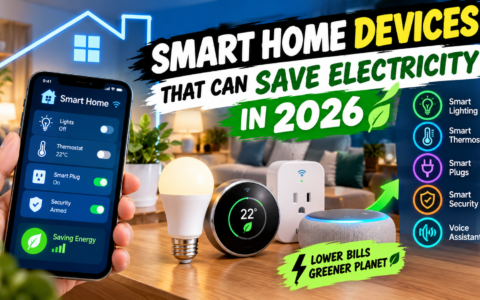
Smart lights, cameras, speakers, thermostats and cleaning devices can work together through a central ecosystem.
A homeowner might use a voice command to turn off lights, adjust the temperature and start a cleaning routine.
The real benefit appears when different devices communicate smoothly rather than operating as isolated products.
Before buying, check compatibility with your existing smart-home platform.
14. What Should You Check Before Buying an AI Gadget?
The word “AI” alone should never determine your purchase.
Start by asking what the device actually does.
A useful checklist includes:
AI Features
Look for specific functions rather than vague marketing claims.
Subscription Costs
Some advanced AI features may require monthly or annual payments.
Smartphone Compatibility
Certain gadgets depend heavily on companion apps.
Internet Requirements
Find out whether important functions work offline.
Privacy
Check what information the device collects and where it stores that data.
Software Support
Long-term updates can determine how useful an AI gadget remains after purchase.
15. AI Gadget Privacy Matters
AI devices can collect more personal information than traditional electronics.
A smart camera may capture video around your home. AI glasses can record images. Voice assistants and AI recorders may process audio.
Therefore, privacy should become part of your buying decision.
Read the manufacturer’s privacy policy before purchasing. Check whether you can disable certain features, delete stored data and control cloud access.
Convenience is valuable, but personal data deserves protection.
16. Are AI Gadgets Worth Buying in 2026?
AI gadgets can absolutely be worth buying when they solve genuine everyday problems.
A smart device becomes more valuable when it saves time, improves accessibility or removes repetitive work. Novelty alone, however, does not justify a high price.
The strongest AI products in 2026 are increasingly blending into familiar devices.
Smart glasses look like glasses. AI earbuds look like earbuds. Smart rings look like ordinary rings. Robot vacuums quietly handle household chores in the background.
That subtle integration may become one of the biggest advantages of AI hardware.
Best AI Gadget by Category
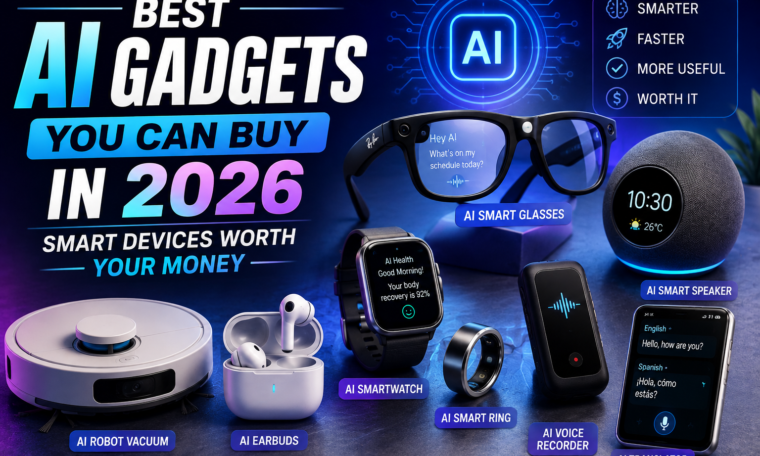
| AI Gadget | Best For |
|---|---|
| AI Smart Glasses | Hands-free assistance |
| AI Smart Ring | Sleep and wellness insights |
| AI Smartwatch | Everyday productivity |
| AI Earbuds | Calls and voice assistance |
| AI Recorder | Meetings and lectures |
| AI Robot Vacuum | Automated cleaning |
| AI Security Camera | Home monitoring |
| AI Smart Speaker | Smart-home control |
| AI Translator | Travel and communication |
| AI Fitness Tracker | Activity insights |
How to Choose the Right AI Gadget
Start with your daily routine.
If you travel frequently, translation technology or AI glasses could make sense. Someone attending several meetings every week might benefit more from an AI recorder.
Fitness enthusiasts can explore smart rings and AI watches. Meanwhile, homeowners may get greater value from AI security cameras, robot vacuums and smart speakers.
Budget also matters.
There is no reason to spend ₹50,000 on an AI gadget if a ₹5,000 device can solve the same problem.
Conclusion
The best AI gadgets you can buy in 2026 are not necessarily the most futuristic products. Instead, the strongest devices are those that use artificial intelligence to solve practical problems.
AI smart glasses can provide hands-free assistance, while smart rings and watches can turn wearable data into useful insights. AI earbuds make voice interaction more convenient, and intelligent robot vacuums can reduce household work.
For professionals, AI recorders can save time during meetings and interviews. Smart cameras can make home monitoring more useful, while translation gadgets can help travellers communicate across languages.
Before spending money, compare the AI features, price, subscription requirements, privacy controls, compatibility and software support.
Most importantly, ask yourself one simple question: Will this gadget genuinely make my daily life easier?
If the answer is yes, the device may be worth buying. If the only attraction is the word “AI” on the box, your money may be better spent elsewhere.