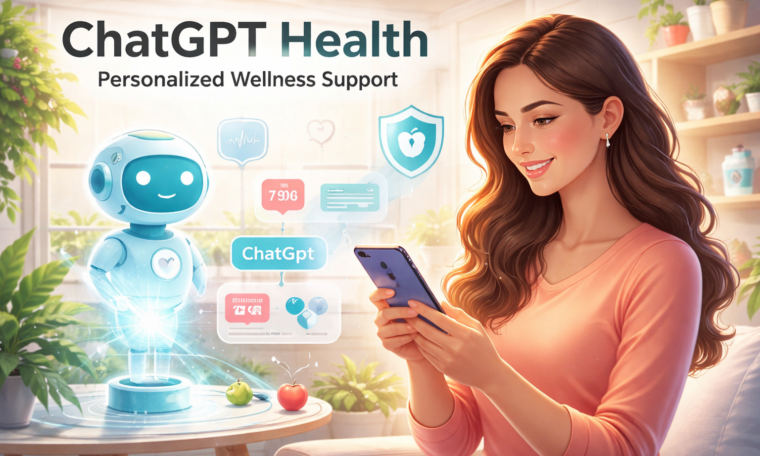
ChatGPT Health, Healthcare has always been personal. But navigating it? That often feels confusing, overwhelming, and frustrating. From juggling medical records to remembering test results, prescriptions, symptoms, and doctor visits—it’s a lot. Now, OpenAI wants to change how people interact with their own health information.
On January 8, OpenAI officially introduced ChatGPT Health, a new AI-powered experience designed to help users better understand, organise, and engage with their health and wellness data. The idea is simple yet ambitious: combine your personal health information with ChatGPT’s intelligence to make health conversations clearer, more relevant, and easier to manage.
But what exactly is ChatGPT Health? How does it work? And more importantly—what does it actually mean for everyday users?
Let’s break it down, without the medical jargon or tech overload.
What Is ChatGPT Health? A New Chapter for AI in Healthcare
At its core, ChatGPT Health is a specialised version of ChatGPT that allows users to securely connect their medical records and wellness apps inside a dedicated, protected space.
Instead of asking generic health questions, users can now have conversations grounded in their own health data. That means responses are more personalised, context-aware, and useful.
Think of it like upgrading from a general health encyclopedia to a private health assistant that understands you.
OpenAI says this experience is meant to help people feel more informed, prepared, and confident when navigating everyday health questions—without replacing doctors or clinical care.
Why OpenAI Built ChatGPT Health in the First Place
Health-related questions already make up one of the biggest use cases for ChatGPT. According to OpenAI, hundreds of millions of users ask health and wellness questions every week.
At the same time, trust in healthcare systems is being tested. Appointments are short. Paperwork is endless. And patients often feel left in the dark.
Fidji Simo, CEO of Applications at OpenAI, summed it up clearly:
The healthcare system isn’t working well enough—for patients or doctors.
That’s where AI comes in. Not as a replacement, but as support.
ChatGPT Health is OpenAI’s attempt to turn AI into a personal health companion, helping users understand their information before, during, and after medical care.
| Feature | ChatGPT Health | Regular ChatGPT |
| Medical Record Sync | Yes (via b.well integration) | No |
| Privacy | Encrypted & Isolated Space | Standard Encryption |
| Training Data | Not used to train models | Used (unless opted out) |
| Accuracy | High (Grounded in your data) | General Knowledge only |
A Personal Super-Assistant for Your Health Journey
OpenAI isn’t hiding its bigger vision here. ChatGPT Health is another step toward turning ChatGPT into what the company calls a “personal super-assistant.”
One that helps you across different parts of life—starting with health.
Whether it’s preparing questions before a doctor’s appointment, understanding lab results, tracking wellness goals, or simply learning more about your body, ChatGPT Health aims to be there as a supportive guide.
Not a decision-maker. Not a doctor. But a helpful co-pilot.
Doctors Are Already Turning to AI—and Fast
This move didn’t come out of nowhere.
The American Medical Association recently revealed that physician use of AI nearly doubled between 2023 and 2024. Even more striking—68% of doctors say AI gives them an advantage in caring for patients.
On the patient side, OpenAI-commissioned research shows that three out of five adults in the US used AI tools for health or healthcare in the past three months. And among them, 75% found AI extremely or very helpful.
In other words, both sides of the healthcare equation are already using AI. ChatGPT Health simply formalises and strengthens that relationship—while putting user control front and center.
How ChatGPT Health Actually Work
So how does this new experience differ from regular ChatGPT?
ChatGPT Health lives inside a dedicated health space within the chatbot. Everything related to your health—files, conversations, connected apps—stays isolated from your other chats.
This separation isn’t just cosmetic. It’s a deliberate privacy and security measure.
Users can securely connect:
- Medical record
- Wellness app
- Health data from supported platform
Once connected, ChatGPT can use this information to give more relevant, personalised responses during health-related conversations.
Privacy, Security, and Data Control: A Major Focus
Health data is sensitive—and OpenAI knows it.
ChatGPT Health builds on ChatGPT existing privacy framework with additional layers of protection, including:
- Purpose-built encryption
- Data isolation
-
compartmentalize health conversation
OpenAI has clearly stated that:
- Health conversations stay inside the ChatGPT Health space
- Data does not flow into other chat
- Health data is not used to train foundation AI model
In short: your health data stays your.
This emphasis on control and transparency is critical at a time when data privacy concerns are higher than ever.
Design with Doctors, Not Against Them
One of the biggest fears around AI in healthcare is replacement. OpenAI addresses this directly.
ChatGPT Health is not meant to diagnose conditions or prescribe treatments. It does not replace doctors, nurses, or clinical care in any form.
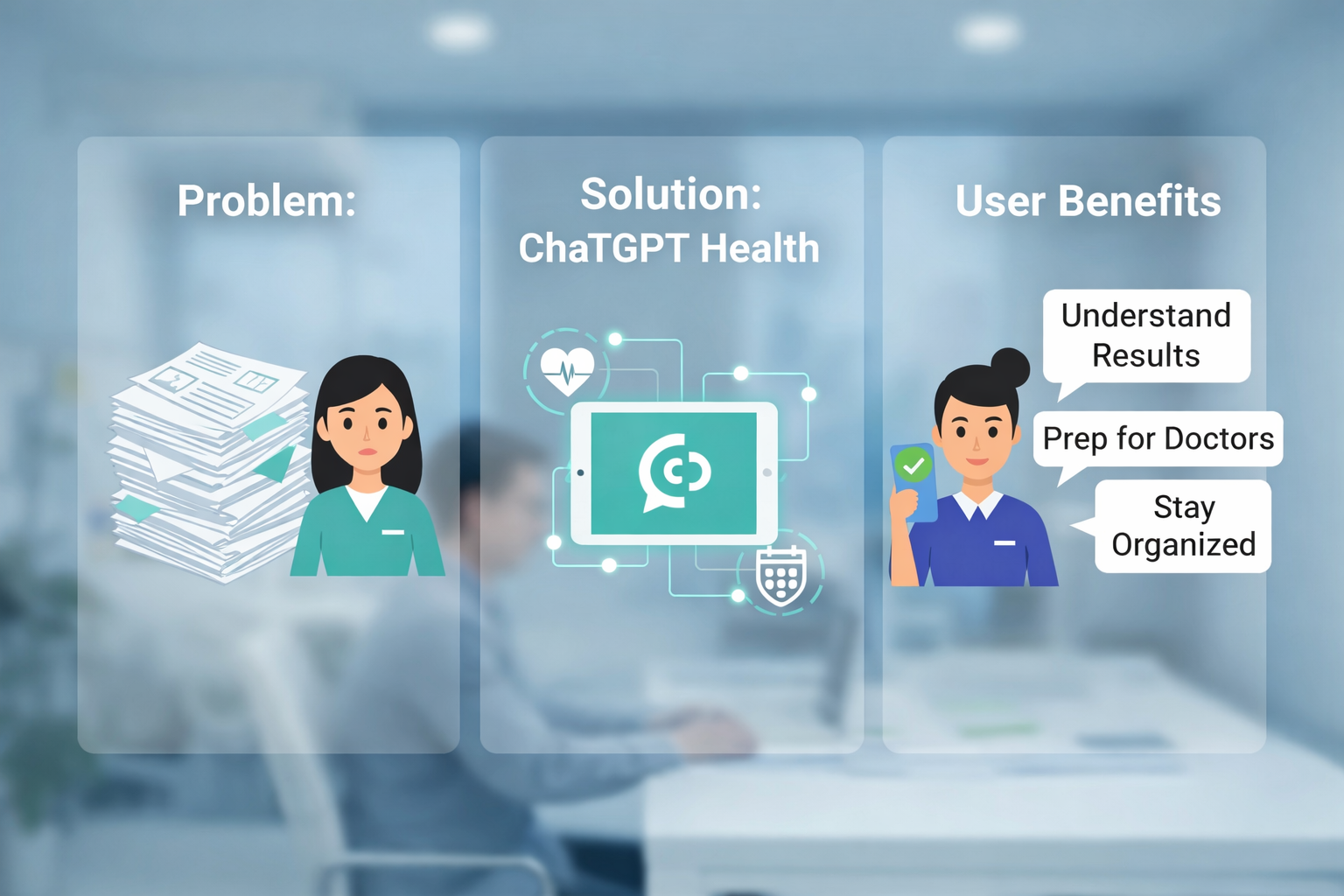
Instead, it’s designed to help users:
- Understand medical information
- Ask better questions
- Stay organised
- Take a more active role in their health
OpenAI says the product was developed in close collaboration with physicians, ensuring it supports—not disrupts—real medical workflows.
Think of it as a bridge between medical appointments, not a substitute for them.
Putting Users in Control of Their Health Data
OpenAI has partnered with digital health platform b.well to handle secure health data connectivity. Through this integration, users can explicitly authorise ChatGPT to access their medical records from participating US healthcare providers.
Nothing happens automatically. Users choose:
- What data to connect
- When to connect it
- How it’s used in conversations
This approach flips the traditional model. Instead of data being locked away in systems you rarely access, ChatGPT Health brings it directly into your hands—securely.
Who Can Access ChatGPT Health Right Now?
ChatGPT Health is rolling out gradually.
To get started, users must:
- Sign up for a waitlist
- Receive access approval
- Enable ChatGPT Health from the ChatGPT sidebar
At launch, some features—like connecting medical records—are limited to the United States. OpenAI has confirmed plans to expand availability over the coming weeks, though a full global rollout timeline hasn’t been announced yet.
This phased approach allows OpenAI to refine privacy safeguards and user experience before expanding worldwide.
What ChatGPT Health Can (and Can’t) Do
Let’s be clear.
What It Can Do
- Help explain health information in plain language
- Provide context-aware wellness guidance
- Support preparation for medical visits
- Improve understanding of personal health data
What It Can’t Do
- Diagnose medical conditions
- Replace doctors or clinical care
- Prescribe treatments or medication
ChatGPT Health is designed to support everyday health navigation—not to practice medicine.
Why This Matters for Everyday Users
For users, the real value lies in clarity and confidence.
Healthcare often feels like a maze. ChatGPT Health aims to turn it into a conversation—one that’s informed by your own data and explained in language you understand.
It’s like having a well-read friend who knows your health history, speaks clearly, and never gets tired of answering questions.
And in a world where people are increasingly expected to manage their own health journeys, that kind of support can make a real difference.
Conclusion
ChatGPT Health marks a significant moment in the evolution of AI-powered healthcare tools. It doesn’t promise miracles. It doesn’t replace doctors. And it doesn’t pretend to have all the answers.
What it offers instead is something more practical—support, clarity, and control.
By securely connecting personal health data with conversational AI, OpenAI is reshaping how people interact with their own wellness. Not as passive patients, but as informed participants.
Healthcare may still be complex. But with tools like ChatGPT Health, understanding it just became a little easier. AI in healthcare isn’t about machines taking over. It’s about people being better equipped.
ChatGPT Health reflects a growing belief that technology should adapt to humans—not the other way around. And if done responsibly, securely, and transparently, it could help millions feel more confident navigating one of the most important parts of life: their health.
The future of wellness support is personal. And now, it’s conversational too.
FAQ: ChatGPT Health – Everything Users Want to Know
Q1. What is ChatGPT Health and how is it different from regular ChatGPT?
ChatGPT Health is specialize health experience that lets you connect your medical records and wellness data in a private space so you can get more personalised, context-aware health explanations. Unlike regular ChatGPT, it is built specifically around health information, stronger privacy controls, and does not use your health data for training the core AI models.
Q2. Can ChatGPT Health replace my doctor or medical professional?
No. ChatGPT Health is not a doctor and does not replace medical professionals, diagnoses, or treatments. It is designed to help you understand your health information, prepare better questions, and feel more confident before and after appointments—not to make medical decisions.
Q3. Is my medical data safe with ChatGPT Health?
ChatGPT Health is built with extra layers of privacy and security, including encrypted storage, an isolated health space, and strong data controls. Your health conversations stay in this protected section and are not used to train base AI models, and you decide what to connect and what to share.
Q4. Does ChatGPT Health have access to all my medical records automatically?
No. ChatGPT Health cannot see your records unless you explicitly connect them. You choose which healthcare providers or platforms to link, what information to share, and you can disconnect access at any time.
Q5. Who can currently use ChatGPT Health?
ChatGPT Health is being rolled out gradually. Some features, like connecting to healthcare systems for medical records, are initially available only in select regions, with plans to expand over time. Access may start with a waitlist or invite-based rollout.