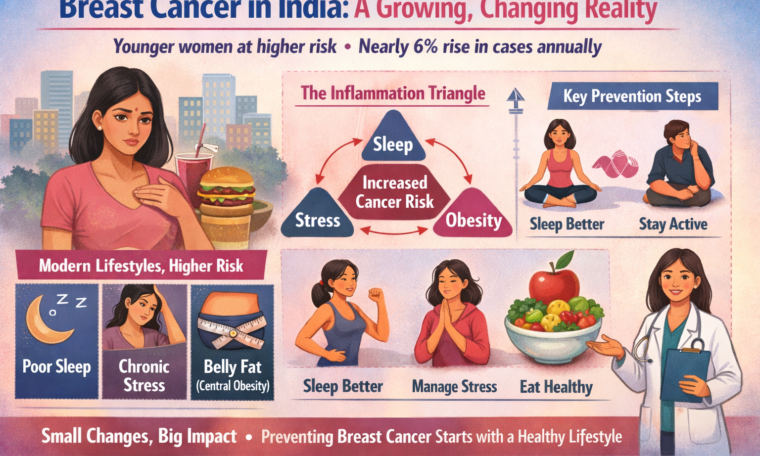
Breast cancer is no longer a distant concern or a disease of “later life” for Indian women. It’s here, it’s rising, and it’s arriving earlier than ever before. According to recent data from the Indian Council of Medical Research (ICMR), breast cancer cases among Indian women are increasing at an alarming rate of nearly 6% every year. That’s not just a statistic—it’s a wake-up call.
What’s more unsettling is why this is happening. Genetics still matter, yes. Age still matters, of course. But a growing body of evidence now points to something far more within our control: how we live, how we sleep, how we eat, and how we manage stress.
Poor sleep, chronic stress, and increasing belly fat—also known as central obesity—are emerging as powerful contributors to breast cancer risk. And unlike genes, these are things we can actually change.
In this in-depth, conversational deep dive, we unpack how modern lifestyles are reshaping breast cancer risk in India, why younger women are increasingly affected, and—most importantly—what practical steps can truly help reduce that risk.
Breast Cancer in India: A Growing, Changing Reality
Breast cancer has now overtaken cervical cancer as the most common cancer among Indian women. Once considered a disease predominantly affecting women over 50, it is increasingly being diagnosed in women as young as their late 30s and early 40s.
Urbanisation, desk-bound jobs, fast food, late nights, emotional overload, and shrinking sleep hours have quietly rewritten the risk equation. As Dr. Shubham Garg, Director of Surgical Oncology at Dharamshila Narayana Hospital, Delhi, points out—our bodies are paying the price for modern living.
This isn’t about blame. It’s about awareness.
The Sleep–Cancer Connection: More Than Just Fatigue
Let’s start with sleep—the most underestimated pillar of health.
How Strong Is the Evidence Linking Poor Sleep to Breast Cancer?
The evidence is no longer anecdotal. Indian data is now catching up with global research. Recent findings from the National Centre for Disease Informatics and Research (NCDIR) have added strong Indian context to the growing link between disrupted sleep, circadian rhythm disturbance, and breast cancer risk.
Sleep isn’t just rest. It’s repair.
When sleep is poor or irregular, it disrupts:
-
Melatonin production (a hormone with anti-cancer properties)
-
Estrogen regulation
-
Immune surveillance (your body’s ability to detect abnormal cells)
-
DNA repair mechanisms
Poor sleep alone may not cause cancer—but when combined with obesity, chronic stress, sedentary habits, and urban lifestyles, it creates fertile ground for disease.
Is Poor Sleep as Dangerous as Genetics or Age?
Let’s be clear—poor sleep doesn’t outrank age or genetic predisposition. Those remain the strongest non-modifiable risk factors.
But here’s the shift: poor sleep has emerged as one of the most important modifiable risk factors.
Clinicians are increasingly seeing breast cancer cases in women who:
-
Have no family history
-
Are relatively young
-
Have experienced years of sleep deprivation
-
Work night shifts or irregular hours
-
Live under constant stress
-
Show signs of metabolic dysfunction
In short, sleep deprivation has moved from “bad habit” to clinical concern.
Why Belly Fat Is More Dangerous Than Overall Weight
Many women focus on weight—but doctors focus on where the weight sits.
Central Obesity vs Overall Obesity
Central obesity refers to excess fat around the abdomen. This visceral fat isn’t passive padding—it’s metabolically active and deeply problematic.
Visceral fat:
-
Releases inflammatory chemicals
-
Promotes insulin resistance
-
Raises estrogen levels
After menopause, fat tissue becomes the primary source of estrogen. More belly fat means more estrogen, which fuels hormone-receptor-positive breast cancers.
That’s why waist circumference is a stronger predictor of breast cancer risk than BMI.
In simple terms:
A slimmer waist matters more than a lower number on the scale.
The Inflammation Triangle: Sleep, Stress, and Obesity
Poor sleep, chronic stress, and central obesity don’t act alone. They form a dangerous triangle.
-
Stress raises cortisol
-
Cortisol disrupts sleep
-
Poor sleep worsens insulin resistance
-
Insulin resistance promotes fat storage
-
Fat increases inflammation and estrogen
It’s a vicious cycle—and breast cancer thrives in inflammatory environments.
Can Lifestyle Changes Really Lower Breast Cancer Risk?
This is the most important question—and the answer is encouraging.
Lifestyle Changes Don’t Eliminate Risk, But They Reduce It Significantly
Improving lifestyle factors can:
-
Restore circadian rhythm
-
Normalize melatonin levels
-
Strengthen immune response
-
Lower estrogen production
-
Reduce chronic inflammation
-
Improve insulin sensitivity
Even for women already treated for breast cancer, these changes reduce recurrence risk and improve outcomes.
Lifestyle medicine isn’t optional anymore—it’s preventive oncology.
Chronic Stress: The Silent Tumour Enabler
Stress isn’t just emotional. It’s biochemical.
How Chronic Stress Alters Tumour Biology
Long-term stress causes sustained cortisol release, which:
-
Suppresses immune surveillance
-
Reduces the body’s ability to eliminate abnormal cells
-
Disrupts glucose metabolism
-
Alters estrogen pathways
-
Fuels systemic inflammation
Over time, stress doesn’t just affect mood—it reshapes the biological environment, making it more cancer-friendly.
In other words, unresolved stress quietly opens the door.
Why Younger Indian Women Are Getting Breast Cancer
One of the most worrying trends is the rise in breast cancer among women aged 35–50 years.
What’s Driving This Shift?
Many of the same risk factors seen in Western countries are now common in India:
-
Sedentary lifestyles
-
Central obesity
-
Chronic stress
-
Poor sleep
-
Delayed childbirth
-
Reduced breastfeeding
Add to this delayed diagnosis, lack of awareness, and limited access to early screening—and the risk multiplies.
Prevention in India cannot rely on mammography alone. It must include lifestyle education, metabolic health monitoring, stress management, and sleep hygiene—starting early.
Delayed Childbirth: Should Women Be Worried?
This topic needs nuance—not fear.
Delaying childbirth slightly increases lifetime estrogen exposure, which can modestly raise breast cancer risk. But cancer is not inevitable.
Many women delay pregnancy for valid reasons—career, finances, personal readiness.
How Risk Can Be Balanced
Risk can be mitigated by:
-
Maintaining healthy weight
-
Staying physically active
-
Prioritising sleep
-
Managing stress
-
Breastfeeding when possible
-
Following appropriate screening schedules
The goal is balance, not panic.
Should Breast Cancer Screening Start Earlier Now?
For women with multiple lifestyle risk factors—yes, earlier screening may be wise.
Who Should Consider Early Screening?
Women with:
-
Central obesity
-
Chronic sleep disruption
-
High stress levels
-
Sedentary lifestyle
-
Hormonal imbalances
A risk-stratified approach works better in India than blanket screening.
Clinical breast exams, ultrasounds, or mammography in the late 30s may be appropriate for higher-risk women, under medical guidance.
Sleep Hygiene: A Powerful, Free Prevention Tool
Good sleep isn’t luxury—it’s protection.
Simple habits that help:
-
Fixed sleep–wake timings
-
Limiting screens before bed
-
Dark, cool sleeping environment
-
Reducing caffeine late in the day
-
Stress-relief rituals before sleep
Think of sleep as nightly maintenance for your immune system.
Movement Over Medicine: Why Exercise Matters
Regular physical activity:
-
Reduces visceral fat
-
Improves insulin sensitivity
-
Lowers estrogen levels
-
Improves sleep quality
-
Reduces stress hormones
You don’t need extreme workouts. Consistency beats intensity.
Even brisk walking, yoga, or strength training 30–45 minutes a day makes a difference.
Community Awareness: The Missing Link
One of the biggest challenges in India is late diagnosis.
Breast cancer outcomes improve dramatically with early detection. Community-level counselling, workplace wellness programs, and public education on lifestyle risk factors are essential.
Prevention must move from hospitals into homes.
Conclusion
breast cancer risk India is no longer shaped only by genes and age. It’s shaped by how we live—every single day.
Sleeping well, managing stress, staying active, and keeping belly fat in check won’t guarantee immunity. But they stack the odds in your favour.
This isn’t about perfection. It’s about awareness.
Your body is constantly listening to how you treat it. Give it rest, movement, and it balance.
And in doing so, you’re not just reducing cancer risk—you’re choosing long-term health.
If there’s one takeaway, let it be this: prevention isn’t dramatic—it’s deliberate. Small lifestyle shifts, practiced consistently, can quietly protect you in powerful ways. And that might just be the most empowering health choice a woman can make today.